
Oiza Yusuf |
In a strategic move to fortify transparency and restore public confidence in the third sector, the Ethics and Good Leadership Awareness Initiative (EGLAI) has launched a comprehensive two-day capacity-building workshop for Civil Society Organisations (CSOs) across Nigeria’s South-West region.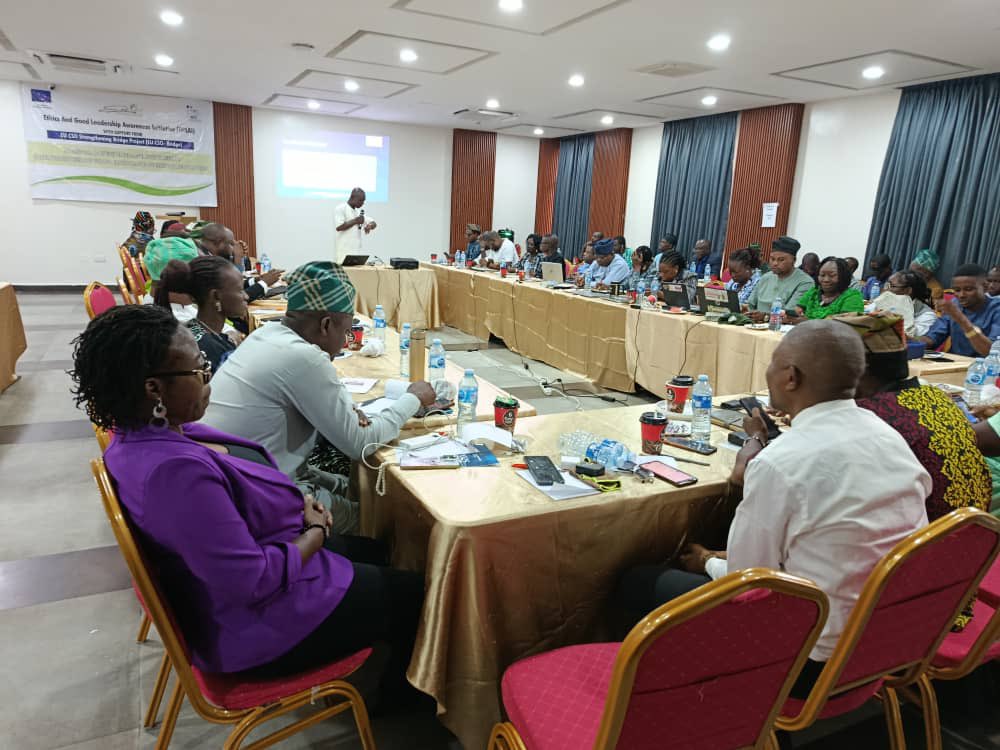
The program, which held on Tuesday and wednesday, at Limeridge Signature Hotel, Ikeja, Lagos State, is designed to equip CSO champions, network leads, and cooperative federations with the tools necessary to navigate a landscape of increasing regulatory pressure and legislative scrutiny to promote good governance within the civic space.
A Unified Front for Accountability
Supported by the European Union-funded CSO Strengthening Bridge Project (EU CSO-BRIDGE) and implemented by the International Institute for Democracy and Electoral Assistance (International IDEA), the workshop brought together delegates from Lagos, Ogun, Oyo, Osun, Ondo, and Ekiti states.
The diverse cohort includes media professionals and high-ranking executives from various Cooperative Federations, highlighting the intersection between community-based financial models and broader civic governance. Notable attendees included Elder Isaac Aladesiun of the Ekiti State Cooperative and Ebun Akin-Falaiye, Executive Secretary of the Lagos State Cooperative Federation.
Strengthening Internal Governance
Addressing participants during the opening session, Dr. Harry Udoh, Team Lead of EGLAI, emphasized that self-regulation is the most effective defense against unethical practices that have historically clouded the sector’s reputation.
“Your reputational value is directly proportional to the number of persons who know you,” Udoh stated, urging CSOs to be more intentional about showcasing their interventions. “The Self-Regulation movement will tackle and expose ‘ghost’ CSOs, reform the sector, and ensure that we do more in solving community problems, effectively becoming an ‘alternative government’ that keeps the country safe and stable.”
Udoh further noted that the train-the-trainer model ensures the impact extends beyond the workshop, as participants are expected to cascade the lessons learned to their respective states.
The Human Element of Regulation
Reinforcing the necessity of personal accountability, Idem Udoekong, Project Manager for the EU CSO-BRIDGE Project at International IDEA, reminded the attendees that institutional integrity begins with the individual.
“It is about you. Individual self-regulation is about trust,” Udoekong informed the participants. “Why should government, partners, and other stakeholders trust you? Self-regulation is self-discipline. It is what makes the government trust your operations.”
Expanding the National Footprint
The South-West engagement follows successful training rounds in the North-West and South-East geopolitical zones. EGLAI Programme Officer, Shiiwua Mnenga, confirmed that the organization plans to replicate these sessions across all geopolitical zones in Nigeria to create a harmonized ethical standard nationwide.
The workshop, themed “Scaling the Adoption of Civil Society Organization (CSO) Self-Regulation in Nigeria,” is expected to result in a more efficient, sustainable, and impactful civic space, fostering a culture where CSOs are viewed as credible partners in national development.
Empowering the Watchdogs: Media’s Role in Civil Society
The organizers emphasized that the media is a pivotal stakeholder in safeguarding civic space and demanding accountability. By providing robust coverage of this workshop, The media can help the public grasp the nuances of CSO self-regulation and see why it is a cornerstone of a healthy democracy.
They added that, wider awareness does more than just inform; it sparks meaningful public dialogue on transparency and compliance. As the role of civil society evolves, this conversation is essential for ensuring organizations across Nigeria continue to drive sustainable, long-term development.