

By Aanosike Somtochukwu |
To tackle the growing threat of climate change, SOS Children’s Village Nigeria has empowered four young Nigerians with ₦2.8 million to implement innovative climate action projects in their communities.
The beneficiaries, Ayodele Joshua, Shukura Akinola, Benita Obot, and Hannah Omokhaye, were selected through a competitive process and will use the funds to kick-start their initiatives.
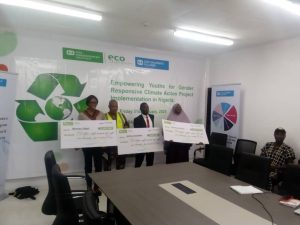
According to Eghosa Erhumwunse, Country Director of SOS Children’s Villages Nigeria, the organization is committed to supporting young people in developing innovative solutions to address climate change.
“We believe that young people have a critical role to play in addressing climate change, and we are committed to supporting them in developing innovative solutions to this global challenge,” Erhumwunse said.
The empowered youths, dubbed “Eco-Champions,” will implement projects focused on climate education, sustainable practices, proper waste management, and disposal.
Shukura Akinola, one of the beneficiaries, expressed her gratitude to SOS Children’s Village Nigeria for the opportunity, stating that the funding will aid her in implementing her project, which focuses on climate education for school children and market women and men.
Akinola, who attended an eco-champion summit in Kenya, said she faced challenges in collaborating with non-governmental organizations, but with the support of SOS Children’s Village, she has been empowered with networks that can aid her activities. Her project, which is focused on climate education, will also encourage sustainable practices, proper waste management, and disposal.
Another beneficiary, Benita Obot, from Cross River, appreciated the organization for giving young people the opportunity to carry out their ideas and implement them. Her initiative, Eco Sustainable Future Initiative, aims to provide climate education and waste management skills for school children in secondary school, with a focus on adolescents.
Obot’s project will provide educational materials, workshops in schools, and teach students how to read, reduce, reuse, and recycle waste. The initiative will also teach students how to make reusable bags, which would help reduce the dependency on plastic bags. Additionally, the project will raise a generation of environmental stewards who will advocate for themselves and their communities.
Joshua Adedoyin, another beneficiary, said his project promotes eco-friendly transportation, advocates for sustainable living, and promotes community engagement. He emphasized that Nigeria is facing economic constraints, and petrol is above what people can survive on. Promoting eco-friendly practices would reduce the burden for parents, and workers can channel more funds into sending their children to school rather than putting their money into petrol.
Adedeyin, who is an SDG advocate, said his project aligns with the United Nations’ Sustainable Development Goal 13, which focuses on climate action.
A climate change advocate, Adewale Ajayi, who was present at the event, lauded the SOS Children’s Village initiative and encouraged the leaders to further drive the message to every community.
The empowerment of the four youths is part of SOS Children’s Village Nigeria’s efforts to address the impact of climate change on children and communities. The organization has been working to support children and families affected by climate change and has implemented various initiatives aimed at reducing the impact of climate change on vulnerable populations.
The event marked the launch of the Eco-Champions project, a pilot initiative that will be scaled up over time. SOS Children’s Village Nigeria is committed to continuing its support for young people in addressing climate change, recognizing the critical role they play in developing innovative solutions to this global challenge.
According to Erhumwunse, the organization expects the beneficiaries to use the funds to kick-start their initiatives and make a positive impact in their communities. He also called on other stakeholders to support the beneficiaries, saying that the impact of their projects can be doubled with more support.
Erhumwunse emphasized that the home is the best place to start addressing climate change, saying that charity begins at home. He noted that the family is the smallest unit of society, and working with families can help to instill the right culture and way of life that can help to address climate change.
Share this