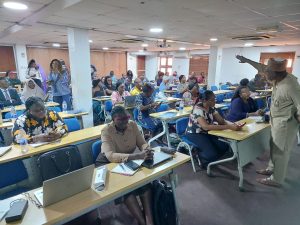
Lagos State has opened a five-day multisectoral workshop to develop its State Action Plan for Health Security (SAPHS), a major step toward boosting preparedness for emerging health threats. The event, holding from November 24–28 at the Lagos Chamber of Commerce and Industry, is convened by the Lagos State Ministry of Health in collaboration with the Nigeria Centre for Disease Control and Prevention (NCDC), with technical support from RTI and the U.S. CDC.
Speaking at the opening, the Special Adviser to the Governor on Health, Dr. Kemi Ogunyemi, stressed that health must now be viewed as a core security issue. She warned that while national conversations often focus on banditry or crime, biological threats remain equally dangerous especially in a densely populated megacity like Lagos.
“Health is security. The next threat may be something we cannot predict. This plan is our shield,’’ she said, urging participants to develop a realistic, actionable framework that will protect residents regardless of future outbreaks.
The Director of Epidemiology, Biosecurity and Global Health, Dr. Ismail Abdus-Salam, said the workshop builds on the 2024 Joint External Evaluation (JEE), noting that Lagos deliberately reflected its true capacity gaps to ensure sustainable improvement. He added that the plan will guide health security investments and implementation from 2026 to 2030.
Representing the NCDC Director-General, the Director of Emergency Preparedness and Response, Pharm. Chibuzor Eneh, reaffirmed the agency’s commitment to Lagos, describing the state as a national leader in health security development. She said additional NCDC teams would join the workshop to support the technical sessions.
Officials from the U.S. CDC, RTI, and the WHO also delivered goodwill messages, praising Lagos for its consistency and urging stakeholders to ensure strong monitoring, documentation, and multisectoral coordination to avoid the low implementation rate recorded in previous national plans.
Participants drawn from human, animal, and environmental health sectors—will work in thematic groups covering surveillance, laboratory systems, antimicrobial resistance, emergency operations, risk communication, and other One Health areas.
The final SAPHS will be validated and forwarded to the Lagos State Executive Council for adoption.
The workshop continues through the week.
Share this