

The African Union Development Agency (AUDA-NEPAD) has launched a bold new vision for the continent’s development, demanding a shift away from historical colonial trade routes toward systems that foster internal wealth.
Speaking at the prestigious CEO Forum in Johannesburg, leadership emphasized that Africa’s physical networks must be fundamentally reimagined to support true economic independence.
For decades, continental transport networks were explicitly designed for extraction serving primarily to move raw materials out of Africa rather than building value within its borders. AUDA-NEPAD is now challenging global and local stakeholders to view infrastructure not merely as asphalt and steel, but as the literal foundation of African economic sovereignty.
From Projects to Systems
As stakeholders aggressively push to make the African Continental Free Trade Area (AfCFTA) a lived reality, the agency is calling for an immediate transition from isolated projects to interconnected systems, and from political declarations to tangible delivery. The goal is to establish industrial ecosystems where trade corridors do more than just move goods; they must actively anchor factories, agricultural hubs, and digital platforms.
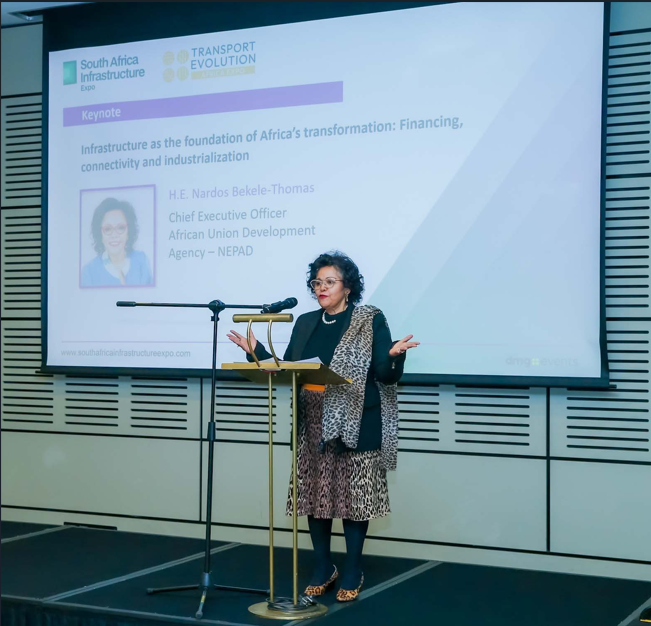
“Africa does not only need more infrastructure it needs infrastructure that changes the structure of our economies, carrying us from projects to systems, from corridors of extraction to corridors of production, and from declarations to delivery.” H.E. Mrs. Nardos Bekele-Thomas, CEO of AUDA-NEPAD
Funding the Future via the 5% Agenda
To finance this massive structural shift, AUDA-NEPAD is championing the 5% Agenda, a strategic initiative calling for a domestic mobilization of capital. The agency is urging a deliberate shift in African institutional capital, specifically targeting pension funds and sovereign wealth assets. By redirecting these domestic resources into regional infrastructure, the continent can self-finance the pillars of its own future competitiveness.
Beyond the physical roads and bridges, the agency highlighted that soft infrastructure is equally vital to success. Harmonized customs procedures and integrated digital trade systems must be standardized across borders to eliminate bureaucratic bottlenecks that currently hinder intra-African commerce.
A Coalition of the Serious
The leadership concluded with a stark warning, noting that the cost of developmental delay on the continent is simply too high. Moving forward, Africa’s economic future will be built by a self-described “coalition of the serious” a group of public and private sector leaders who are entirely ready to move past bureaucratic conversation and transition directly into economic transaction.
Share this


