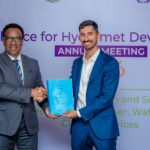

As part of plan in ensuring that Nigeria and other developing countries migrate to alternative source of energy, American billionaire and founder of Bloomberg Philanthropies, Michael Bloomberg, and Chief Executive Officer (CEO), Special Representative of the UN Secretary-General for Sustainable Energy for All, Damilola Ogunbiyi have expand their partnership to mobilise financing for the migration.
The partnership was sealed at the ongoing COP27 Climate Change Conference Sharm El Sheikh, Egypt.
In a piece by Africa Renewal and obtained by MAP NEWS, Bloomberg Philanthropies’ will engage with national and local governments to help them develop energy transition plans and partner with the Glasgow Financial Alliance for Net Zero to mobilise capital for clean energy projects in countries.
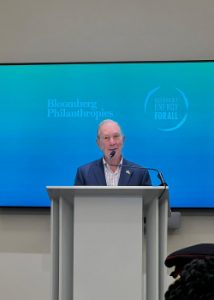
Mr Bloomberg, who is also the UN Secretary-General’s Special Envoy for Climate Ambition and Solutions, said progress was needed in phasing out coal plants worldwide, adding that his philanthropy would expand its clean energy development work in Africa.
Ghana’s President, Nana Akufo-Addo, Ms. Ogunbiyi, and Nigeria’s Minister of Environment, Mohamed Abdullahi underscored the need for a just and fair energy transition for African countries.
Ghana is already thinking along with its Energy Transition Framework, the West African country will harness the opportunity for a fair and equitable energy transition as the country relies on carbon-intensive industries for economic growth.
Ghana will “harness the opportunity for a fair and equitable energy transition as the country relies on carbon-intensive industries for economic growth,” said President Akufo-Addo.
He elaborated on Ghana’s newly released National Energy Transition Framework that will serve as a blueprint for “transitioning Ghana into a climate-resilient low-carbon energy country.”
With a price tag of $562 billion, Ghana’s framework’s implementation will last from 2020 to 2070, although it aims to achieve universal energy access by 2030.
The country will decarbonize its energy sector through carbon capture, utilization and storage technology.
In addition, it will increase the use of electric and hydrogen fuel cell vehicles and efficient end-use appliances.
Ghana also hopes to generate financing through engagements with domestic and development and investment banks, pension funds and other multilateral financial institutions.
We seek a “just and equitable transition both in universal access to electricity and the exploitation of our natural resources to support economic development,” according to Ghana’s Ministry of Energy.
Meanwhile, Ms. Ogunbiyi described as timely Blomberg Philanthropies’ support for a just and equitable energy transition across Africa and Asia.
“The pathway to net zero emissions is to target the eradication of energy poverty, especially in my continent Africa,” she insisted, adding that “energy, climate and development must go hand in hand,” said Ms. Ogunbiyi.
“Short-term challenges must be addressed but not at the expense of long-term sustainability… the $100 billion promised by the developed world has to come to fruition.”
Ms. Ogunbiyi commended Ghana for demonstrating ambition, like numerous other developing countries have done, by developing and implementing “comprehensive, data-driven and investable energy transition plans.”
Ghana joins a growing list of countries, including South Africa and Nigeria, with just energy transition plans.
Nigeria’s Minister of Environment, Mohamed Abdullahi, emphasized that to successfully implement energy transition plans, countries most responsible for carbon emissions must take urgent and decisive actions to support countries contributing the least emissions but are disproportionately affected by the climate crisis.
Share this