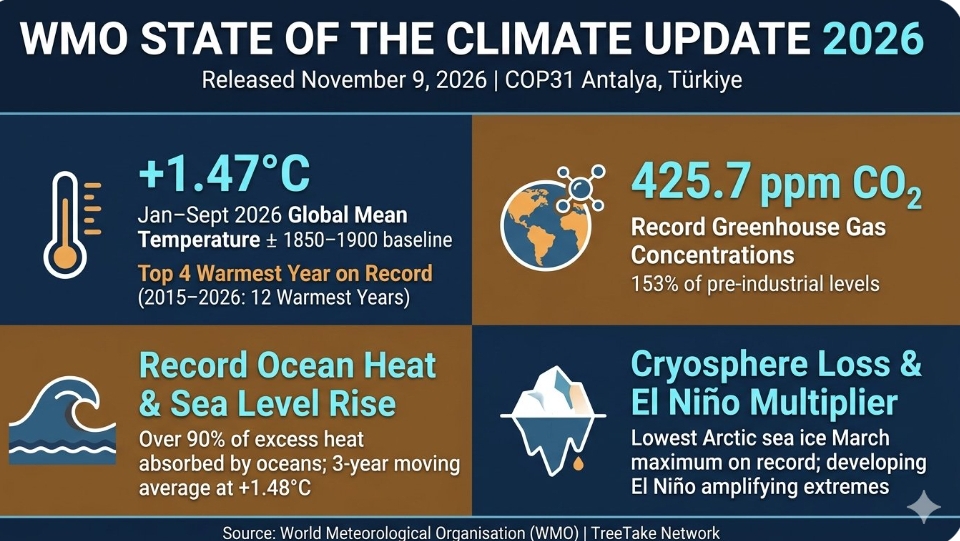
The World Meteorological Organization (WMO) has warned that 2026 is on track to become one of the four hottest years ever recorded, as rising global temperatures, melting glaciers and increasing sea levels continue to worsen climate risks across the world.
The warning is contained in the WMO’s State of the Climate Update 2026, released on November 9 at the opening of the 31st United Nations Climate Change Conference (COP31) in Antalya, Türkiye.
According to the report, the world is experiencing a prolonged period of exceptional temperatures, with a strong El Niño event expected to intensify global warming and extreme weather conditions well into 2027.
The report noted that the past 12 years have individually been the warmest on record, while 2023 to 2026 are expected to rank as the four warmest years since global temperature records began.
Global average surface temperatures between January and September 2026 stood at approximately 1.47°C above pre-industrial levels, with the figure expected to increase before the end of the year due to the warming influence of El Niño.
El Niño Expected to Intensify Global Heat
The WMO explained that El Niño, which has been strengthening since August, is expected to become the strongest on record by December 2026, increasing the likelihood of more extreme temperatures and weather events.
The organisation’s Secretary-General, Celeste Saulo, said the developing El Niño was adding to an already overheated planet, creating further challenges for communities and economies.
“El Niño and indeed the state of the global climate in 2026 gives new meaning to the phrase off the charts. El Niño doesn’t add new heat to the planet. It releases heat from the ocean, which is the warmest ever measured. There is simply more heat available to release,” Saulo said.
She added that extreme weather events were becoming more intense and occurring faster than historical climate records had prepared societies to handle.
“We are supercharging our weather and El Niño will be a risk multiplier. Heatwaves, tropical cyclones, and rainstorms are intensifying faster than our historical baselines prepared us for. Hundreds of millions of people this year have been exposed to unbearable extreme heat, whilst the catastrophic ice and rock collapse and flash floods in Nepal highlighted the compound risks facing communities in fragile, warming high-mountain terrain.”
Ocean Heat and Rising Sea Levels Reach New Records
The report also identified growing ocean temperatures and rising sea levels as major indicators of the worsening climate situation.
According to the WMO, the Earth’s energy imbalance reached its highest level since monitoring began, as greenhouse gases trap increasing amounts of heat and disrupt the balance between energy entering and leaving the planet.
The ocean absorbs approximately 90 per cent of the excess heat generated by global warming, with 2026 expected to mark the tenth consecutive year of record ocean warmth.
Global mean sea level also reached a record high in 2026, continuing a long-term rise driven by melting glaciers and ice sheets, alongside the expansion of seawater as it warms.
The organisation further reported that glaciers lost more than 400 gigatonnes of ice in 2025, equivalent to approximately one millimetre of global sea-level rise.
It estimated that the volume of ice lost during the year would have filled five Olympic-sized swimming pools every second.
The decline in freshwater resources has also continued, with water stored in groundwater, soil, rivers, reservoirs, glaciers and snow decreasing globally since 2014.
Extreme Weather Takes Human and Economic Toll
The WMO report highlighted the growing human and economic consequences of climate-related disasters, including heatwaves, droughts, wildfires, tropical cyclones and flash floods.
In Europe, heatwaves, drought and wildfires contributed to more than 30,000 excess deaths, according to preliminary estimates. At least eight countries also recorded national temperature records, with significant consequences for agriculture, energy and transportation.
In India, an estimated 146.5 million people were exposed to extreme heat during an April 2026 heatwave.
Nepal also experienced devastating climate-related impacts following a Himalayan glacier collapse and downstream flash floods in late August, which killed more than 1,300 people and caused significant economic damage.
The report warned that the developing El Niño could further increase risks to agriculture, particularly in regions where food security depends heavily on rainfall.
Climate Change Poses Growing Public Health Risks
Beyond environmental and economic damage, the WMO warned that rising temperatures and changing weather patterns could worsen public health challenges.
It identified heat-related illnesses and deaths, wildfire smoke, poor air quality, malnutrition, food insecurity and injuries among the potential consequences of intensifying climate conditions.
Changes in rainfall patterns could also affect the spread of water- and vector-borne diseases, including cholera, malaria and dengue.
The report noted that the World Health Organization (WHO) had, for the first time, classified the anticipated health impacts of the current El Niño as a health emergency.
These risks are expected to place additional pressure on vulnerable communities, particularly those with limited access to healthcare, safe water, adequate nutrition and climate protection measures.
Guterres Warns of Growing Climate Inequality
United Nations Secretary-General António Guterres described the current climate situation as a new period of extreme weather, warning that communities least responsible for global warming continue to suffer its worst consequences.
“We have entered a new age of climate extremes. A supersized El Niño is colliding with a planet already superheated by manmade climate change. Climate records keep falling. The human costs keep rising. And those least responsible are suffering first and worst. Leaders must get serious by cutting emissions faster, accelerating a just transition from fossil fuels and delivering the finance and protection vulnerable countries need,” Guterres said.
He emphasised the need for stronger climate action, faster reductions in greenhouse gas emissions and increased financial support for countries facing the greatest climate risks.
WMO Highlights Importance of Early Warning Systems
Despite the worsening climate outlook, the report identified progress in the development of early warning systems designed to protect communities from climate-related disasters.
The number of countries reporting the existence of multi-hazard early warning systems increased from 56 in 2015 to 136 in 2025, according to the report.
The WMO stressed that sustained climate observations and reliable forecasts remain essential for monitoring changes in the global climate and helping governments prepare for extreme weather events.
The State of the Climate Update 2026 was released using available scientific data up to September 2026 and therefore does not capture the most recent impacts of the developing El
Share this