

Eunice Afolabi
The Nigerian government has been advised to address barriers responsible for the increasing number of out-of-school children in the country.
The United Nations Children’s Fund (UNICEF) Country Representative to Nigeria, Peter Hawkins, gave the advise to journalists on a special interview program.
Hawkins pointed out poverty, proximity to school, and inadequate Water, Sanitation, and Hygiene (WASH) facilities, among others, as factors impeding retention in school and the completion of education in the country.
READ ALSO: Out of School Children Feel Mocked When Their Mates Speak English, Says Educationist
According to him, one of the biggest problems is the reduction of the number of schools from basic to post-basic level, especially for the girls.
“What you find is a village where the schools are full of girls and boys, and it is incredible, it is fantastic.
“But immediately they have to go to junior secondary education, you see a massive drop in enrollment and going to school.
“Because of security concerns, distance concerns, poverty concerns, and so on.”
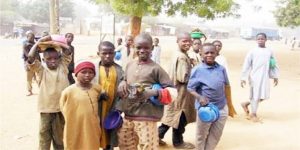
He further explained the issue of access to quality education in many communities, especially rural communities, where children cannot afford to go to school.
The UNICEF official explained that many parents in rural areas have resolved to send their children to towns with the hope that they would get better learning.
He also pointed out the menace of Almajiri (pupils of non-formal Qur’anic Schools) in parts of the country as one of the purposes for the increasing number of out-of-school children.
He also noted that, “And we know that the phenomenon of the Almajiri in different parts of the country has perpetrated a vast number of children who are out-of-school, who are learning, but not the full scope of the learning.
“Spiritual learning is fantastic, and we should encourage it. But it needs to be complemented with numeracy and literacy to ensure that the child has it in the right environment.”
Share this


