
Nigeria and the United States have signed a landmark technical Memorandum of Understanding (MoU) aimed at strengthening cooperation on the early detection, prevention, and control of infectious diseases, while repositioning Nigeria’s health system toward long-term self-reliance.
The agreement covers critical areas including HIV/AIDS, tuberculosis, emerging and re-emerging infectious diseases, disease surveillance, laboratory systems, data integration, primary healthcare delivery, and health workforce development. It also outlines a gradual shift from aid dependence to increased domestic financing of Nigeria’s health sector by 2030.
Under the five-year MoU, running from April 2026 to December 2030, the United States government will provide nearly $2 billion in grant funding, while Nigeria has committed to allocating at least six percent of executed annual federal and state budgets to health, a move expected to mobilise close to $3 billion within the same period. The commitment has already been reflected in the Federal Government’s proposed 2026 Appropriation.
The agreement aligns with Nigeria’s broader health reform agenda, particularly the Nigeria Health Sector Renewal Investment Initiative (NHSRII) launched in 2023. Implemented through a Sector-Wide Approach, the reform seeks to harmonise the efforts of federal, state, and local governments, development partners, civil society, and the private sector under a unified plan, budget, and reporting framework.
In December 2023, President Bola Ahmed Tinubu signed the Health Sector Renewal Compact, bringing together all 36 state governors, the Federal Capital Territory Administration, and development partners. The compact signalled high-level political commitment to building a resilient, efficient, and people-centred health system for Nigerians.
A major pillar of the MoU is enhanced disease surveillance and outbreak response. By 2030, Nigeria aims to detect infectious disease outbreaks with epidemic or pandemic potential within seven days of emergence, notify relevant authorities within one day, and complete initial response actions within seven days of confirmation. To support this goal, the United States will fund a comprehensive assessment of Nigeria’s surveillance systems and provide technical assistance to strengthen rapid response teams, emergency operations centres, infection prevention and control measures, and antimicrobial resistance detection.
The agreement also prioritises the expansion and modernisation of laboratory systems. Nigeria envisions a connected network of at least 12 national and specialised laboratories, 23 regional laboratories, and more than 1,500 sub-national clinical and public health laboratories. While the United States currently funds about $74 million annually in laboratory commodities and supports over 1,100 frontline laboratory personnel, the MoU outlines a phased transition. The U.S. will fully fund laboratory commodities in 2026, after which Nigeria will gradually assume full responsibility by 2030.
In the area of health commodities, Nigeria plans to build a more accountable and integrated supply chain to support universal health coverage, leveraging pooled procurement mechanisms such as MEDIPOOL, alongside national, zonal, and state-level warehousing and distribution systems. The United States currently provides about $133 million annually for commodities covering malaria, HIV, tuberculosis, maternal and child health, and nutrition. As with laboratory supplies, full U.S. funding in 2026 will taper off gradually, with Nigeria taking over full financing by 2030.
The MoU further addresses the sustainability of frontline healthcare workers, with Nigeria committing to progressively integrate U.S.-funded health workers into its permanent workforce by 2030. Both governments agreed to strengthen technical and financial support for doctors, nurses, community health workers, pharmacists, and other essential personnel, while better integrating HIV, TB, and malaria services into the broader health system.
On health data systems, Nigeria reaffirmed its commitment to building an interoperable digital health ecosystem under the Nigeria Digital Health Initiative. The country plans to deploy digital medical record solutions in 20 percent of health facilities by 2026, scaling up to full coverage by 2030. The United States will support improvements to existing electronic health record systems, while both countries explore regulated data-sharing arrangements in compliance with national data protection laws.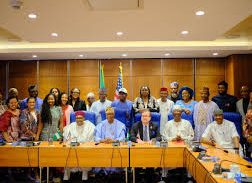
Beyond technical cooperation, the MoU underscores a strategic shift toward domestic financing, private sector investment, and civil society participation, including faith-based organisations, to ensure inclusive access to quality healthcare—particularly for women and children.
Describing the agreement as a bold and forward-looking partnership, the Federal Government said the MoU reflects Nigeria’s determination to build a resilient health system capable of preventing, detecting, and responding to public health threats, while reducing long-term reliance on external aid.
Nigeria also expressed appreciation to the United States and other development partners for their continued support, reaffirming its commitment to transparency, accountability, and sustained reform across the health sector.
Share this