

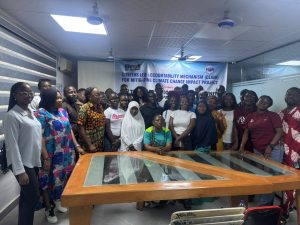
The Lagos State Civil Society Partnership for Development (LACSOP) on Thursday, 4 June 2026, inaugurated the Community Waste Management Group (CWMG) in Lagos, in a renewed effort to strengthen grassroots participation in environmental governance and address persistent waste management challenges contributing to flooding and poor sanitation across communities in the state.
The inauguration brought together civil society actors, community representatives, and environmental stakeholders to deepen collaboration on waste management, promote recycling awareness, and encourage behavioural change at the community level.
The initiative is also expected to strengthen coordination between residents and relevant government agencies, including the Lagos Waste Management Authority (LAWMA), in improving environmental sustainability and reducing flood risks across the state.
Flooding Worsens as Waste Disposal Practices Take Centre Stage
Speaking at the event, the Board Chairman of LACSOP, Barrister Ayo Adebusoye, said flooding in Lagos had become a predictable seasonal challenge rather than an occasional environmental disruption, driven largely by human behaviour and poor waste disposal practices.
He explained that in several communities across the state, drainage channels are frequently blocked by indiscriminate dumping of plastics, household waste, and other solid materials, which worsens flooding during heavy rainfall.
According to him, the problem is not only infrastructural but behavioural, stressing that even where drainage systems exist, improper waste disposal continues to undermine their effectiveness.
Barrister Adebusoye noted that the Community Waste Management Group was established to strengthen community ownership of environmental sanitation, adding that sustainable solutions must begin from households and local communities rather than relying solely on government intervention.
He said the group would serve as a bridge between communities, civil society organisations, and government agencies, focusing on environmental education, monitoring of waste practices, and advocacy for improved sanitation systems across Lagos.
Civil Society Push for Community Action and Environmental Responsibility
Barrister Adebusoye also highlighted the importance of sustained civil society collaboration, noting that initiatives like LACSOP were born out of years of cooperation among NGOs, community-based organisations, and development actors who recognised the need for collective action on development challenges.
He stressed that environmental issues, particularly waste management, require consistent citizen engagement, adding that effective solutions depend on how well residents take responsibility for their immediate surroundings.
He encouraged participants to use social media and community platforms to amplify environmental awareness, describing visibility and communication as key drivers of behavioural change.
The Board Chairman urged members of the newly inaugurated group to serve as “frontline environmental advocates,” mobilising residents, promoting sanitation practices, and supporting community-level monitoring of waste disposal.
He also noted that while environmental challenges are often discussed at policy level, their impact is most visible at the community level, making local action essential.
Newly Inaugurated Members Share Commitments and Early Impact
Some of the newly inaugurated members of the Community Waste Management Group (CWMG) described the initiative as a practical platform for strengthening environmental awareness and promoting community-driven waste management solutions.
One of the members, Abidoye Nofisa of the National Council of Muslim Community Youth, said the programme was both reflective and transformative, noting that it reminded him of earlier lessons on cleanliness and sanitation during his secondary school education.
He explained that the sessions reinforced his commitment to environmental responsibility, adding that he had already begun applying the lessons within his immediate surroundings.
According to him, he encouraged residents in his compound to separate plastic waste from other household refuse, an initiative that led to the collection and recycling of plastics, reducing indiscriminate dumping while improving environmental awareness among neighbours.
He added that beyond environmental cleanliness, the initiative also created small-scale economic value, as recyclable plastics were sold, which encouraged more residents to participate in waste segregation.
Another newly inaugurated member, Veronica Adoga, described the programme as highly impactful and insightful, saying it significantly improved her understanding of climate change and environmental sustainability.
She explained that prior to joining the initiative, her knowledge of environmental issues was limited, but continuous engagement under LACSOP had reshaped her understanding of how individual actions influence environmental outcomes.
Veronica said she had since taken active steps to sensitise friends, neighbours, and other community members on proper waste disposal practices, particularly plastic pollution and drainage blockage.
She further observed that behavioural change was gradually becoming visible in her community, as more residents were beginning to understand the link between waste management and flooding.
Tanimola Yusuf Dauda, another LACSOP member, said the initiative had broadened participants’ understanding of waste as a resource that could be converted into wealth through recycling and upcycling processes.
He explained that the programme had also strengthened community outreach efforts, with participants engaging residents and local leaders on improved sanitation practices.
According to him, these efforts are already beginning to yield results, as more community members are participating in waste recovery activities that also provide informal livelihood opportunities.
The inauguration of the Community Waste Management Group is expected to strengthen collaboration between civil society organisations, government agencies, and residents in addressing waste management challenges, improving environmental sanitation, and reducing flooding risks across Lagos communities.
Share this


