

By Peace Oladipo
Growing up in Southwest Nigeria, Joshua Chibuzor was always captivated by the unseen forces that shaped the world surrounding him. While his secondary school peers spent afternoons playing games under the subtle sunlight of Akure, he delighted in learning about the mysteries of physics.
His fascination eventually led him to pursue a degree in Physics at the Adeyemi Federal University of Education in Ondo State. He was bestowed with theoretical knowledge and a good certificate, but he yearned for more.
“I wanted to know the direct practicalities of the theories of physics. I wanted to see how the equations play out in my environment. That’s why I decided to major in atmospheric science for my master’s degree,” he said.
Nigeria’s premier university, the University of Ibadan (UI) was his next stop. With much enthusiasm and hunger for hands-on experience, he commenced learning atmospheric physics.
Two years later, Chibuzor was about to leave the UI premises disappointed. “I only touched sophisticated equipment twice during my Master’s degree. And honestly, I am not satisfied with how many times I used them,” said Chibuzor, with a downturned face.
It was his convocation week, but his excitement was tempered by two contrasting emotions: the thrill of completing his course and the disappointment of feeling underprepared in terms of technical skills, the primary purpose of his enrollment.
For his postgraduate research, Chibuzor intended to create artificial intelligence that would have enabled him to predict future trends in atmospheric conditions. However, the inability to obtain dependable variables and equipment made him suspend the research and opt for a simpler topic.
A Solution Hidden Behind Bushes
Meanwhile, a solution capable of addressing Chibuzor’s discontent was a Laboratory for Atmospheric Research, located at the Olajuwon Olayide Extension of the University.
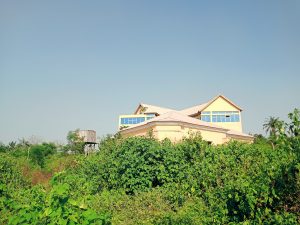
A thick bush was beheld when this reporter visited the laboratory’s location in November. She had to push through the dense and overgrown bush, fighting her way past thick branches and thorny vines to gain entry.
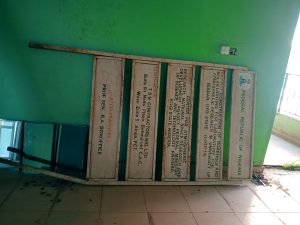
A complementary project signpost in the entrance room of the research centre. Photo Credit: Peace Oladipo.
A billboard disclosing the complementary project of borehole construction and solar-powered light for the facility was in the entrance room.
Despite being unused, the paintings were peeling off, windows broken, ceilings missing, and spirogyra formed on interior walls. Further exploration of the facility revealed some iron doors were becoming rusty and stiff, and heavy cobwebs and weeds slowly thriving due to the facility’s long-term abandonment.
“The last time work was done here was early last year”, said a man working close to the building. 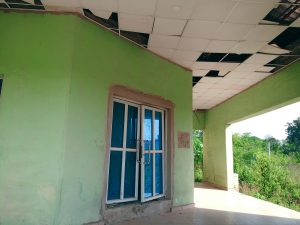
Missing ceilings and unstable door. Photo Credit: Peace Oladipo.
Its existence is unknown. Another graduate student of atmospheric physics, Ruth Bankole, said, “An atmospheric research lab would have made my research process easier because I would have easy access to observational data and be able to do simulations for future projections of weather patterns.”
Believing in the transformative potential of the facility, she explained how a functional research lab fosters interdisciplinary research as she could work with professionals from meteorology, geophysics or any other environmental science, greatly improving her knowledge and advancing her career in climate research.
Beyond its benefit to students, UI could possess undiluted and first-hand information about weather patterns, changes and occurrences to be able to mitigate natural disasters in the nation.
Chronicles of the Laboratory for Atmospheric Research Centre
The narrative commenced when the management of UI visited the former Deputy Senate Majority Leader, Ajayi Boroffice. The 2019 visit to Boroffice, a UI alumnus of Genetics and former lecturer, was described as a positive strategy to mobilize the alumni network for the advancement of the citadel of learning. To the management, he promised to give back.
A few months later, a project titled, ‘Construction of a Laboratory for Atmospheric Research’, was nominated as a Zonal Intervention Project by Senator Boroffice, who represented Ondo North for twelve years. 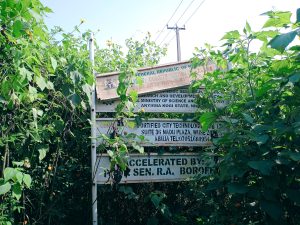
The project’s signpost overwhelmed by overgrown grass. Photo-Credit: Peace Oladipo
In a letter dated 3, October 2020, Boroffice informed the former school’s vice-chancellor, Professor Abel Idowu, about the project, to be supervised by the Centre for Atmospheric Research of the National Space Research and Development Agency (CAR-NASRDA). An engineering firm, Fortified City Technologies Limited was also contracted to execute the work.
According to information on the Budget Office of the Federation portal, ₦50 million was allocated in 2020, ₦60 million in 2021, and another ₦60 million in 2022, bringing the total allocation for the project to ₦170 million.
The amount disbursed for this project could not be ascertained, as the contractor to whom the project was awarded could not be traced. Their contact details were not available on social media or through a Google search. Inactive was attached to its name, upon a search on the Corporate Affairs Commission portal.
“The Laboratory was not handed over to us” – The Physics Department
During this reporter’s visit to the physics department, some lecturers admitted the existence of the project, but the students found the information new. “Some hoodlums vandalized the building about a year ago,” one of the lecturers, anonymously mentioned. “Then, the university management asked the department to inspect it.”
From the conversation with the lecturer, it was discovered that the facility was not properly handed over to the department to become useful and functional, despite “being completed.”
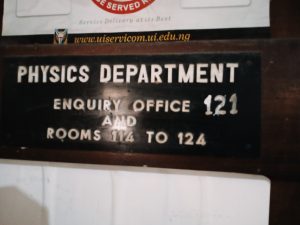
The newly instated Head of the Department of Physics, Professor Rachel Obed, was absent during the visit. Through a phone conversation, she said, “I am just hearing about this”, noting that her subunit was not the atmospheric unit expected to be working closely with the facility.
Less than 24 hours after the call, Professor Obed followed up with this reporter, explaining her intention to investigate the facility thoroughly. However, her plans were halted due to ongoing departmental accreditation activities, she revealed this through a text message.
Senator Boroffice and Agency Unresponsive
Boroffice was contacted through his mobile numbers by this reporter ten times between November 18 and November 25 but none of the calls were answered, while some did not go through. An email was also sent to him, however, neither was it checked nor responded to.
For the agency in charge, a Freedom of Information request was submitted through the email displayed on the website of CAR-NASRDA on November 11, 2024, seeking details about the project, including the money spent, the level of the project completion, and reasons for abandonment.
Following that, phone calls were made through the displayed phone numbers on the agency’s website. The call was received by a male who said, “This information is way above my pay grade, I am not the right person to talk about it. Today is not a good day for this kind of discussion, we are having a serious issue in the office.”
Before the end of the call, this reporter called his attention to the FOI request sent to the email which was checked immediately after the phone conversation.
On 22 November, another call was made to remind the agency of the FOI, “The request you sent, I already forwarded it to the appropriate person expected to respond. I am on a field trip now, but I will contact them. ….. they will respond to your letter, don’t worry,” was the man’s response.
As of the time of filing this report, 4 weeks after the FOI request submission, no response has been given. This purely violates the FOI Act 2011, which mandates a seven-day response period for FOI requests.
Similarly, an FOI request submitted physically to the parent agency, the National Space Research and Development Agency (NASRDA) in Abuja received no response.
CAR leaves UI’s Lab, NASRDA Aids Oyo Streets Cleaning
Amidst the lab hullabaloo, the parent agency has other surprising priorities for Oyo, found outside its mission. 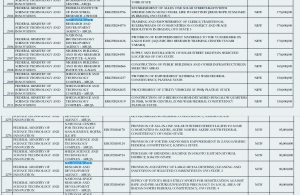
Screenshot of the NASRDA budget
The space agency’s mission, as stated on its website is to vigorously pursue the attainment of space capabilities and the enhancement of the quality of life of mankind through space-related research and development, capacity building in the fields of science, engineering, space law, and the administration for sustainable national development. Contrary to this, was found in the budget.
For Ibadan, the agency’s 2024 capital projects had items like the ‘Training and Empowerment of Clergy, traditional Rulers/Heads of Communities on Conflict and Peace Resolution in Ibadan of Oyo state’ with the sum of N 170 million, the same amount allocated for the atmospheric research laboratory.
Another, which raises eyebrows is the project titled ‘Provision and Supply of Large Metals Dustbins, Cleaning and Sanitation of Selected Communities in Oyo State’, to which N80 million was also allocated.
The projects are classic exhibitions of Ultra Vires, actions taken by an agency beyond its legally defined mandate and authority, explained Baba Machina, a community engagement specialist with Spotlight for Transparency and Accountability Initiative.
“Every ministry or agency is designed for a specific purpose,” he said. “But, most Nigerian agencies are usually seen going beyond their constitutional limits and mandates. This undermines the democratic framework and can lead to misallocation of resources and reduction of public trust.”
BudgIT, a civic organization that promotes budget transparency, stressed in a video the broader issue of the members of the Nigeria National Assembly being responsible for inserting unrelated projects into agency budgets for their gain.
Viewing the issue as a contrast, Machina urged the government to prioritize worthy projects beneficial to the growth of society and hand them over to the target beneficiaries after completion, instead of reckless abandons.
For the time being, Nigeria’s space agency focuses on sweeping the streets of Oyo, while the nation’s dreams of sending a man or woman to the moon fade quietly into the background.
This report was published with support from the Civic Media Lab.


