

Fawaz Adebisi |
“I was able to use my phone very easily and faster before,” said Boluwatife Abigail, a digital marketing enthusiast, who now struggles to navigate her digital life after losing her sight three years ago.

To use her phone, she now depends on a screen reader to help her navigate through apps and messages.
However, because she sells online, she continues to struggle, learning the terrain, especially as “many digital products in Nigeria are not designed inclusively”.
“I want to learn digital marketing, content creation, script writing, and virtual assistant, for my business, those are the skills I want to acquire,” she said.
“But it is tough,” she lamented, stressing that while her screen readers make her work on her phone to some extent, she still has to rely on people to do certain things.
For Abigail, navigating the digital world has become a new challenge since she lost her sight. For Ifeanyi Philomena, a counsellor and entrepreneur who is totally blind, the struggle to access digital services has been part of her experience for much longer.
 When Philomena registered for the 2021 JAMB examination, the process required an email address, but her screen reader could not read all sections of the registration form.
“This TalkBack that is the screen reader on our phones, it’s not everything that it will read for you, it’s not everything,” she said.
She eventually asked someone for help, but the helper, trying to get it done quickly, registered the profile with his own email address.
Years later, while preparing for graduation, Philomena discovered that her name was missing from the JAMB matriculation database. She had also lost access to the profile created with the helper’s email address, which he could no longer remember. The situation left her unable to resolve the problem independently.
“It was a distressing moment,” she said as the problem got resolved only when she travelled to a JAMB office, where staff created a new profile with her own email address. Without that, she would have been unable to register on the NYSC portal.
Not only on JAMB portal, she also encountered another barrier on the National Identity Management Commission platform while trying to correct her records as her screen reader would reach certain sections and fall silent, leaving her unable to tell what was on the page.
To help, a sighted person filled the form on her behalf, the helper misspelt her name, entering “Phillomena” with a double “L”, creating an error she then had to pay for.
With her years of experience in the digital space, Philomena laments the bad digital infrastructure in Nigeria. In her words, it’s on two sides; users need the skills and tools to access digital services, as the services themselves need to be designed so those tools can work.
Abigail and Philomena are just part of a large, often overlooked population navigating a digital transformation that was never designed with them in mind.
The World Health Organisation estimates that at least 2.2 billion people globally live with some form of vision impairment, with at least 1 billion cases preventable or yet to be addressed.
Nigeria’s national blindness and visual impairment survey, published in May, 2009, also estimated that among adults aged 40 and above, about 4.25 million people were visually impaired or blind. Of these, approximately 1.13 million were completely blind, while about 2.7 million had moderate visual impairment and 400,000 had severe visual impairment.
Also, a 2024 systematic review covering 13 Nigerian states found a mean prevalence of 3.9 percent for mild visual impairment and 0.3 percent for severe visual impairment among children.
Yet the country has limited capacity to provide specialised eye and disability services. Nigeria has roughly 700 ophthalmologists serving a population of more than 200 million , about one ophthalmologist for every 285,000 people, far above the World Health Organisation benchmark of one for 50,000.
At the same time, more Nigerians are being pushed towards digital platforms. For visually impaired Nigerians, owning a smartphone, having data and installing a screen reader does not guarantee digital independence, as the final barrier is often the website or service itself.
The Nigerian Communications Commission reported 134 million active mobile internet connections in October 2024. Globally, the International Telecommunication Union reported that 68 percent of the world’s population was online in 2024, while more than 30 percent remained offline.
However, being connected is not the same as being included, as a person may have a smartphone, data and a screen reader and still be locked out.
The accessibility gap is visible online
 A technical assessment conducted in March, in collaboration with Samuel Kalu, an artificial intelligence and machine-learning engineer at Peepalytics AI, examined selected government, civil society and disability-rights websites for potential accessibility barriers.
Kalu, who has seven years of experience in AI engineering, worked with the reporter to develop a Python-powered checker using Selenium and the axe accessibility testing engine. The tool scanned the supplied web pages for selected issues, including missing alternative text, colour contrast, heading structure, ARIA attributes and keyboard-navigation-related problems.
Among government platforms, the assessment identified potential accessibility gaps on the websites of JAMB, the National Identity Management Commission (NIMC), the Nigeria Immigration Service and the Corporate Affairs Commission (CAC). JAMB’s page was flagged for issues involving image alternative text, colour contrast and heading structure. NIMC and the Nigeria Immigration Service also recorded heading-structure issues, while the CAC page was flagged for colour contrast and heading structure.
The assessment also identified gaps among civil society and disability-rights organisations. BudgIT’s page was flagged for issues involving colour contrast, image alternative text and heading structure. JONAPWD’s page had issues involving image alternative text and heading structure, while Tracka was flagged for missing alternative text and keyboard-navigation-related issues. SERAP’s page recorded issues involving colour contrast and heading structure.
Unlike the other platforms, the NCPWD page had no violations flagged by the automated checker in the specific features examined. However, this does not establish that the website is fully accessible to blind and visually impaired users.
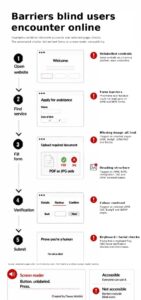 Kalu clarified that the assessment covered only the specific web pages supplied for testing. He explained that the checker did not crawl entire websites, test online forms or transactions, or directly assess compatibility with screen readers such as TalkBack, NVDA and JAWS.
He therefore cautioned that the findings should not be interpreted as a definitive assessment of the websites’ overall accessibility or compliance with WCAG standards.
Rights exist, but digital accessibility remains less explicit
Nigeria ratified the United Nations Convention on the Rights of Persons with Disabilities (CRPD) in 2010 and subsequently enacted the Discrimination Against Persons with Disabilities (Prohibition) Act, 2018, which was signed into law in January 2019.
The Convention’s Article 9 requires countries to ensure that persons with disabilities have equal access to information and communications, including information and communications technologies and electronic services. Article 21 further requires governments to provide public information in accessible formats and technologies appropriate to different disabilities, without additional cost.
Nigeria’s Disability Act prohibits discrimination against persons with disabilities, including in the provision of goods, services and facilities. However, its detailed accessibility provisions focus largely on physical structures, roads and transportation.
Although it contains provisions relating to accessible information and participation in public life, it does not set out specific technical requirements for government websites, online forms and digital public services.
Likewise, the 2023 Accessibility Regulations similarly focus substantially on physical structures and transportation.
There are, however, separate government standards addressing the issue. The National Information Technology Development Agency’s Standards and Guidelines for Government Websites direct government institutions to provide equal access to website information and functionality and adopt the Web Content Accessibility Guidelines (WCAG), which set internationally recognised standards for web accessibility.
However, the existence of these standards has not necessarily translated into accessible digital services across government platforms, as the technical assessment identified potential accessibility gaps on several of the pages examined.
Corroborating this, a 2025 situational analysis by the Global Disability Fund found that Nigeria’s disability law failed to adequately provide for areas including digital accessibility, gender equality and reasonable accommodation, and concluded that much of the country’s disability legislation and policy remained inconsistent with the Convention.
More Visually Impaired Nigerians are losing opportunities
Visually impaired Nigerians have reported losing important opportunities because they cannot independently complete online forms, navigate applications or access other digital services.
Like Adams Esther, a visually impaired small-business owner in Lagos, she narrated how she lost a scholarship opportunity from the Nigerian Content Development and Monitoring Board Foundation.
“I have filled every other thing, I just needed someone to help me crosscheck,” she said. But after a sighted helper checked her information, he changed some of her information with the thoughts of fixing an error.
Because she could not independently review the form, he submitted incorrect details. Waiting excitedly, Esther got a message via mail informing her of the error, which automatically disqualified her.
 For another visually impaired professional, Oluwakemi Odusanya, the barrier was political participation. In 2022, while she was in India, she attempted to replace her damaged Permanent Voter’s Card through the Independent National Electoral Commission’s online system.
The process required facial verification that she could not complete independently. “I tried doing it myself, I could not,” she said, lamenting that “at some point, it was frustrating.” As a result, she did not participate in the 2023 election.
Odusanya’s experience did not end with the INEC disappointment, when she later sat for a professional examination organised by the Chartered Institute of Personnel Management, she could not use her own screen reader because of concerns that it might amount to malpractice.
Instead, another person read the questions aloud. For mathematics questions, the arrangement became especially difficult. “The person cannot even pronounce the signs and symbols,” she said.
What lack of access to digital infrastructure means to Caleb Ogunyemi, an elderly man in Ijebu, Ogun State, is different.
To Ogunyemi, it means hardship as he lost his sight in 2023. Before then, the pastor, farmer and certified teacher ran a tutorial centre in Ijebu, Ogun State.
However, since losing his sight, he has struggled to prepare lesson notes and sermons independently as many of his books are available only in hard copy, while WAEC syllabus materials he needs are incompatible with his screen reader.
Therefore, he has not been able to teach or earn income from teaching for almost three years. To access his bank app, he describes it as “difficult” as he has to give his phone to a sighted person to help. “I would prefer to be the one handling my banking app myself, but it’s impossible,” he said.
Despite existing disability-rights provisions and government standards on accessibility, blind Nigerians continue to encounter barriers in accessing digital services. Disability advocates and technology trainers are, however, developing approaches that show what more inclusive digital participation could look like.
Building accessibility into the technology
While visually impaired Nigerians continue to encounter barriers online, some organisations are working on two fronts; equipping them with the skills to use assistive technology and advocating for more accessible digital services.
 One of them is AccessTech Innovation and Research Centre, whose model combines digital-skills training with access to assistive technology.
Its co-founder, Emmanuella Akinola, said the organisation has trained almost 1,000 visually impaired people in Nigeria and other African countries.
According to Akinola, its programmes cover smartphone and computer use, Microsoft Office, screen readers, digital safety, online banking, digital marketing, data analytics and artificial intelligence.
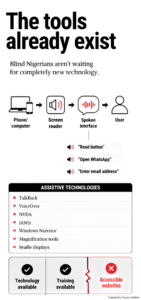 “Participants learn to use tools such as TalkBack, VoiceOver, NVDA, JAWS and Microsoft Narrator, while people with low vision can use magnification and zoom tools,” she said.
She further said AccessTech has created “Gifted to the Blind”, a crowdfunding initiative designed to connect visually impaired people who need digital products with donors.
Like Akinola, in Ibadan, one of the people building that response is himself blind.
Olufemi Bayode, chief consultant and chief product officer of Special Learning Needs Consultants, provides IT training for people with visual impairment and helps businesses make their services accessible to them.
“I am in Nigeria with visual impairment,” he said, stressing that “ whatever I am doing must first be usable for and by a person with visual impairment before any other person.”
In his words, this principle has shaped how he trains. For an Excel manual, Bayode takes conventional instructions written for sighted users and translates each task into keyboard and screen-reader steps.
He tests the material across NVDA, JAWS, Narrator and VoiceOver, and across different Excel versions because software changes can create new barriers.
The organisation also produces accessible e-books and audio resources and tests digital services. Last year, according to the organization’s product officer, it tested an e-Tranzact banking app to determine whether blind customers could use it.
Bayode said he has trained more than 200 visually impaired people, including learners who went on to work with Excel, data and other digital tools. One former trainee, a blind software developer, now builds add-ons for the NVDA screen reader, including a tool that allows users to label unlabelled buttons on websites.
Another trainee, an accountant who lost her sight after university, was nearly sent back from her post because her organisation believed its data platform was inaccessible. Bayode tested it and found that the platform could be navigated with the right skills. She now manages her workflow, conducts financial analysis and audits accounts herself.
“Some of them have never even touched a computer before until they met me,” Bayode said, “ adding that they are using those skills till today.”
For Bayode, effective training is about understanding, not simply completing a course. “What actually works is handling the curriculum with the purpose of ensuring that the person understands what you are teaching,” he said, adding that “memorisation without meaningful learning is meaningless.”
Also, for Akinola, “one of the things that we are proving that works is that if you are teaching a visually impaired person, it must be a small class size,” stressing that it helps teachers monitor students and provide adequate support.” Teaching someone to place their hands on a keyboard for the first time, she explained, requires one-on-one support.
‘Design with us in mind’
“You can’t plan for us without us,” said Oluwatomisin Adeyefa, executive director of Beyond Limits Initiative for Women and Girls with Disabilities.
Adeyefa argues that training blind Nigerians to navigate technology is only part of the solution; the technology itself must be designed with them in mind.
During a 2024 virtual training on digital safety and online harassment, her team found that their conferencing platform frequently hung or skipped, while some controls were unlabelled and difficult for blind participants to navigate.
They abandoned the platform for a more accessible one and shared materials through email and WhatsApp. The training later grew into the Beyond Limits Sisterhood, a community where participants could continue learning and supporting one another.
For Adeyefa, accessibility should not be an optional feature. Blind users should be involved in designing and testing the digital systems they are expected to use.
She noted some signs of progress, including automatic image descriptions and captions on some platforms and improved accessibility in some Nigerian banking apps, but said such features need to become standard rather than exceptions.
‘Our barriers’
The first barrier is cost. Assistive technology remains prohibitively expensive: Bayode notes that a single JAWS screen-reader licence costs between ₦600,000 and ₦1 million, while an Orbit Braille display costs around ₦2 million.
“How will a person with visual impairment be able to make use of all these devices,” he asked, “when they are very, very critical in learning digital skills?”
Akinola of AccessTech lists the same obstacles, devices, data, transport, and poverty above all. “A lot of blind persons don’t have access to a good working computer,” she said. “Because of that, they’re not able to practise their learnings on their own at home.”
She added that it is more reason AccessTech pairs skills training with its “Gifted to the Blind” e-crowdfunding platform, which connects visually impaired people who need devices with those willing to provide them.
The changemakers also mentioned supply geography as a challenge. Bayode can count the genuinely high-standard training centres in Lagos on one hand: “We are just three… Look at the population we have in Lagos compared to those three centres. How many can we take?”
He lamented that none has hostel facilities, leaving learners from other states to cover training, accommodation and feeding costs that are “very high.”
Another problem they mentioned is that training cannot fix inaccessible platforms. Oluwakemi could not vote because of a facial-verification wall; Philomena’s screen reader fell silent on the NIMC portal no matter how skilled she became; also, Abigail can use her phone to run her business, but creating TikTok videos presents another challenge. The accessibility audit behind this series identified accessibility gaps across the assessed platforms.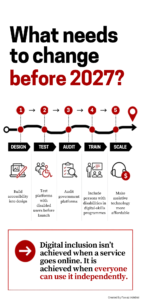
They therefore asked the government to mandate accessibility standards and audit every government website, especially the INEC and NIMC portals, “so that using a screen reader, you can use any website belonging to government”; create national digital-skills and assistive-technology hubs across the six geopolitical zones and subsidise assistive devices in partnership with manufacturers.
This report was commissioned by the Centre for Journalism Innovation and Development (CJID) under its Local Media Sustainability Programme (LMSP), with funding support from the Royal Norwegian Embassy.
Share this


