

As climate change continues to trigger extreme weather events globally, the integration of meteorological data into human activities and industries operations has become imperative.
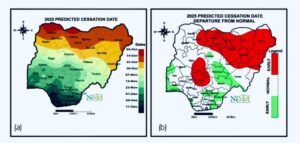 The Nigerian Meteorological Agency (NiMet) in February released its 2025 Seasonal Climate Prediction (SCP), providing critical insights into expected weather patterns including the onset and cessation of the rainy season, dry spell occurrences, temperature forecasts, across the country, and the socio-economic implications of these predictions.
Rainfall and Temperature Forecast
The NiMet’s 2025 predictions indicate significant regional variation in rainfall patterns. Southern states such as Delta, Bayelsa, Rivers, Anambra, and parts of Lagos will experience early rainfall, while northern and central states, including Plateau, Kaduna, and Benue, will face delayed onset of rains. Rainfall cessation is expected to occur earlier than usual in the northern states, while some southern states may experience a prolonged rainy season.
In terms of temperature, above-average temperatures are expected nationwide, particularly in early 2025. April is predicted to be cooler than normal in some areas, but the overall trend points to higher-than-usual temperatures, especially during January, February, March, and May.
The 2025 SCP predicts dry spells in some areas, with the northern states expected to experience longer dry periods of up to 21 days, while southern states will only be susceptible to moderate dry spells. These dry conditions, particularly in the north, may affect agriculture and water availability.
NiMet also highlights the risks of disease outbreaks, such as meningitis and malaria, based on climate indicators like humidity and temperature. The agency warns that meningitis risks will remain high in northern regions, particularly from January to May, with increased vigilance required in areas like Sokoto, Zamfara, and Katsina. Malaria risks will also vary by region, with higher vigilance required in coastal and southern states due to high humidity levels.
2025 SCP Implications for Major Economic Sectors in Nigeria
The 2025 SCP highlights a number of implications for various key economic sectors in Nigeria as well as recommendations for operators across the various sectors such aviation, agriculture, water resources, transportation, among others to prepare for the anticipated climate challenges in order to mitigate risks and optimize operations.
NiMet forecasts normal to slightly warmer temperatures across most of the country, impacting aviation by reducing air density, increasing fuel consumption, and raising operational costs. High-intensity rainfall is expected in several states, increasing risks of wet runways, runway excursions, and accidents. Other hazardous weather conditions, such as thunderstorms, wind shear, and dust haze – prevalent between November to February, could lead to flight cancellations, diversions, and visibility challenges. To mitigate these risks, aviation operators are advised to comply with safety regulations, enhance runway drainage systems.
According to NIMet’s 2025 SCP, the agricultural sector is highly susceptible to the predicted climate conditions, particularly the delayed onset of rains in the north and below-normal rainfall in many areas. Farmers are advised to adopt drought-tolerant, early-maturing crops, and implement soil water conservation techniques. Livestock production could also be affected by heat stress. Farmers are urged to ensure adequate cooling and ventilation for animals.
Effective water resource management will be critical in 2025, as NiMet forecasts normal to below-normal rainfall in some areas, potentially affecting drinking water, agriculture, and industrial use due to delayed groundwater recharge and reduced surface water availability. Increased evaporation from higher temperatures may also lead to water scarcity in vulnerable regions. To address these challenges, NIMet advised authorities to plan water release schedules based on forecasts, develop water rationing strategies for peak demand, and ensure coordination among agriculture, energy, and water-dependent sectors for equitable distribution. Additionally, rainwater harvesting techniques should be implemented, and drainage systems should be cleared to prevent urban flooding during heavy rains.
The transportation sector, particularly road networks, is vulnerable to both fooding and road degradation due to predicted high rainfall and extreme temperatures. NIMet advised authorities to clear drainage systems, reinforce critical infrastructure before the rainy season, and maintain road safety through cautious driving in wet conditions.
The report also outlines the climatic implications for other key subsectors, including telecommunications, energy, maritime, oil and gas, power, and coastal tourism. It advises stakeholders across these sectors to adopt robust infrastructure, implement proactive measures, and engage in comprehensive planning to minimize the impacts of the 2025 climate challenges and ensure safety and operational continuity.
Share this


