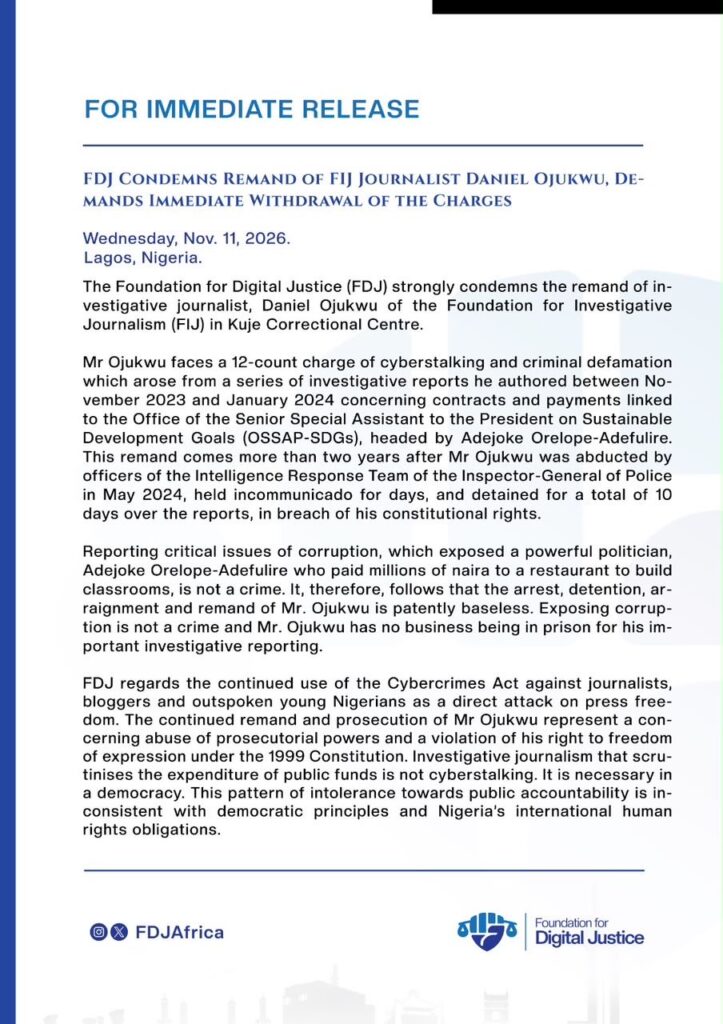
The Foundation for Digital Justice (FDJ) has condemned the remand of Foundation for Investigative Journalism (FIJ) reporter, Daniel Ojukwu, at the Kuje Correctional Centre, demanding the immediate withdrawal of the charges against him over investigative reports on alleged irregularities in contracts awarded by the Office of the Senior Special Assistant to the President on Sustainable Development Goals (OSSAP-SDGs).
In a statement issued on Wednesday, November 11, 2026, FDJ described the charges of cyberstalking and criminal defamation against Ojukwu as baseless, arguing that investigative journalism exposing the management of public funds should not be treated as a criminal offence.

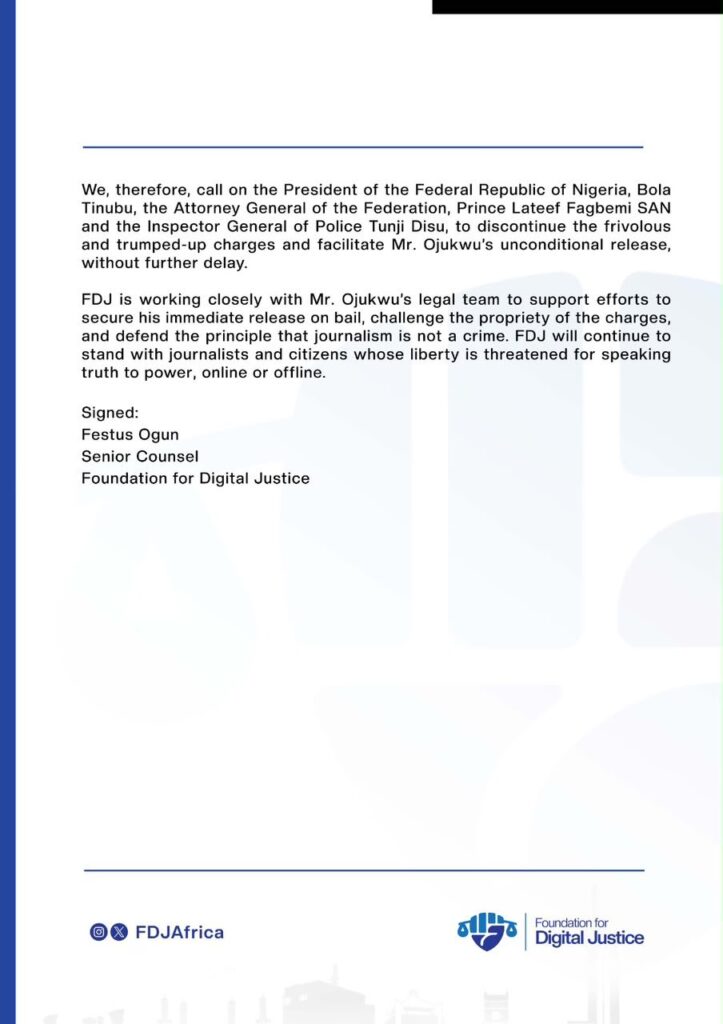
The organisation also called on Bola Tinubu, the Attorney General of the Federation, Lateef Fagbemi, and the Inspector-General of Police, Tunji Disu, to discontinue the charges and facilitate the journalist’s unconditional release without further delay.
Court Remands FIJ Journalist Until December 1
Ojukwu was remanded on Tuesday by the Federal High Court in Abuja following his arraignment on a 12-count charge brought against him and FIJ founder, Fisayo Soyombo, by the Nigeria Police Force.
The presiding judge, Joyce Abdulmalik, ordered that the journalist be held at the Kuje Correctional Centre until December 1, when his bail application is scheduled to be heard.
The charges, dated September 19, 2024, accuse Ojukwu and Soyombo of cyberstalking and criminal defamation over investigative reports published on FIJ’s website between November 2023 and January 2024 concerning the activities of the OSSAP-SDGs, then headed by Adejoke Orelope-Adefulire, a former deputy governor of Lagos State.
During Tuesday’s proceedings, Ojukwu pleaded not guilty to all 12 counts read to him. The prosecution, led by Kunle Lawal, informed the court that Soyombo was at large and sought a bench warrant for his arrest. However, the judge declined the request, explaining that Soyombo had not yet been brought before the court.
Following Ojukwu’s plea, the prosecution requested that he be remanded in custody. His defence counsel, Atanda Kayode, opposed the application, drawing the court’s attention to a pending bail application filed on Monday.
Kayode also asked the court to allow Ojukwu to continue enjoying the administrative bail previously granted by the police, which the defence said he had never violated. However, Justice Abdulmalik rejected the request, stating that the bail application was not yet ripe for hearing and subsequently ordered his remand until December 1.
Charges Linked to Investigative Reports on N147m Classroom Contract
The police charges stem from four investigative reports published by FIJ between November 2023 and January 2024, which examined payments and contracts linked to the OSSAP-SDGs under Orelope-Adefulire.
One of the reports, published on November 7, 2023, and titled Special Report: 2 Weeks Before End of Buhari’s Tenure, Special Assistant, Adefulire Paid a Restaurant N147.1m to Build Classrooms in Lagos. A Lot Was Amiss, questioned the payment of N147.1 million to a restaurant for classroom construction in Lagos.
Another report published on December 3, 2023, titled How Orelope-Adefulire’s OSSAP-SDGs Paid N47.5m for Shady Contract on Amosun’s Request, examined a N47.5 million classroom construction contract awarded to Tru3 Nigeria Limited. FIJ raised questions about the contractor’s status, alleged failure to mobilise to the project site and the payment for what it described as a vague block of classrooms.
The other reports included a November 9, 2023 publication examining how the Economic and Financial Crimes Commission (EFCC) secured the forfeiture of N241 million linked to the SDGs office, and a January 21, 2024 report which alleged that solar panels installed at classroom blocks in former Ogun State Governor Ibikunle Amosun’s district stopped working one week after installation.
According to the charge sheet, the police accused the journalists of conspiring to commit cyberstalking and criminal defamation, alleging that some of the reports were intended to harass Orelope-Adefulire, put her in fear of death or bodily harm, and damage her reputation.
The charges also alleged that the journalists knowingly published false and defamatory information about the former Lagos deputy governor. Six counts relate to cyberstalking, while the remaining six concern criminal defamation.
Ojukwu Was Previously Detained for 10 Days in 2024
The latest remand order comes more than two years after Ojukwu was detained by officers of the Nigeria Police Force over the same investigative reports.
In May 2024, the journalist went missing after leaving his residence, with his phones switched off and his whereabouts unknown to colleagues, family members and friends. FIJ subsequently reported him missing and made enquiries at police stations in the area where he was last known to have travelled.
His family and employer later discovered that he had been taken by officers of the Intelligence Response Team (IRT) of the Inspector-General of Police and held incommunicado at the State Criminal Investigation Department in Panti, Lagos.
He was subsequently transferred to the Nigeria Police Force National Cybercrime Centre in Abuja, where he spent additional days in detention. In total, Ojukwu was held for 10 days before his release on May 10, 2024, following public outcry and pressure from human rights advocates.
At the time, police spokesperson Muyiwa Adejobi said the journalist’s arrest followed a petition accusing him of violating the Cybercrimes Act. The police investigation was linked to the FIJ report concerning the N147.1 million payment to a restaurant for classroom construction.
Before Ojukwu’s detention, the police had also invited and questioned Bukky Shonibare, chairperson of FIJ’s Board of Trustees, in Abuja over the publication. Ojukwu subsequently appeared before the police several times in connection with the investigation, while his passport was reportedly withheld over concerns that he might flee the country.
FDJ Raises Concerns Over Press Freedom
Reacting to the latest development, FDJ described the continued use of the Cybercrimes Act against journalists, bloggers and outspoken Nigerians as an attack on press freedom and freedom of expression.
The organisation argued that investigative journalism which scrutinises public expenditure cannot reasonably be classified as cyberstalking, adding that the prosecution and continued detention of Ojukwu raise concerns about the exercise of prosecutorial powers and the protection of constitutional rights.
FDJ further maintained that the development was inconsistent with democratic principles and Nigeria’s international human rights obligations, warning against the use of criminal charges to discourage reporting on public officials and government spending.
The organisation said it was working closely with Ojukwu’s legal team to secure his immediate release on bail, challenge the propriety of the charges and defend the principle that journalism should not be criminalised.
FDJ reiterated its commitment to supporting journalists and citizens whose liberty is threatened for speaking out on issues of public interest, both online and offline, insisting that exposing alleged corruption should not be grounds for imprisonment.