
Eunice Afolabi
The International Press Centre (IPC) Lagos, Nigeria and Institute of Media and Society (IMS), implementing partners of component 4 (Support to media) the European Union Support to Democratic Governance in Nigeria-Phase 2 (EUSDGN II) Project, took part in the formal
The Delegation of the European Union (EU) to Nigeria and the ECOWAS in partnership with the Independent National Electoral Commission (INEC),
International Press Centre (IPC) Lagos, Nigeria and Institute of Media and Society (IMS), implementing partners of component 4 (Support to media) the European Union Support to Democratic Governance in Nigeria-Phase 2 (EUSDGN II) Project, formally launched the second phase of the of European Union’s flagship democracy support program in Nigeria, which is expected to be implemented from 2022-2027.
READ ALSO: CSOs, Regulatory Agencies Meet To Brainstorm Towards Effective Service Delivery
It also signalled the end of the first phase of the EU’s flagship democracy support programme in Nigeria.
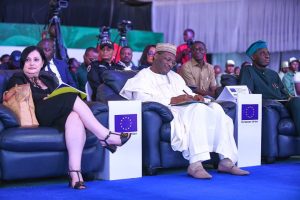
The event which was held at the International Conference Centre (ICC), Abuja, on Monday, September 12, served as an opportunity to learn from the EU’s democratic and governance support to Nigeria and learn from its partners. It also allowed attendees to gain insights into the plans for the second phase of the project.
It was a gathering of technocrats consisting of Ambassador Samuela Isopi, EU Ambassador to Nigeria and ECOWAS, the EU Delegation to Nigeria represented by Laolu Olawumi, INEC’s leadership, Prof. Mahmood Yakubu, Chairman INEC, Chief Technical Adviser to the INEC Chairman, Professor Bolade Eyinla, Mr. Rotimi Oyekanmi, Chief Press Secretary to INEC Chairman former Chairman INEC Prof Attahiru Jega, Professor Anthonia Simbine former National Commissioner INEC.
In his goodwill message, EU Ambassador to Nigeria, Samuela Isopi, noted that, “The EU Support to Democratic Governance in Nigeria (EU-SDGN) program underscores our continued partnership with the Government of Nigeria, a partnership that has grown in mutual respect and benefit since Nigeria’s return to democratic rule in 1999.
“The support to democracy worldwide is not just consistent with the European Union’s fundamental principles it is in our clear interest, and remains a crucial tool for our foreign policy engagement. It is our firm belief that only a functioning democracy can address its citizen’s needs, meet their demands, and fulfill their aspirations. Strong democratic institutions, therefore, are vital for sustainable growth, and for improving a country’s resilience.
“The support to the electoral process as part of the EU’s cooperation policy is of utmost importance for two main reasons. First, the rule of law, human rights, and democracy are the founding principles of the EU and its constituent treaties.
“Second, these principles are central to the EU-Nigeria Partnership as reflected in the Joint Ministerial Roadmap. This is why the European Union’s election assistance programs are a fundamental part of our action to promote democracies, good governance, human rights, and civil society participation.”
“Furthermore, the EU Electoral Observation Missions are a highly visible demonstration of the EU’s commitment to supporting democratization, with a focus on promoting country-owned democratic processes.’
“Phase I of the program contributed to the reform of the electoral process in Nigeria by building capacities, strengthening institutions, and contributing to the reform of the legal framework, political education, advocacy, political dialogue as well as inclusion This, with particular focus on Independent National Electoral Commission (INEC), the National Assembly, Political Parties, Media and the Civil society.
“The Identification and Formulation of Phase II of the program was done in consultation with the Nigerian Government and key stakeholders such as the INEC and civil society groups The EU will continue to provide targeted support by building on the successes of the past electoral cycles and taking forward the very significant lessons learned within the period.
“As the largest democracy in Africa, the integrity of elections in Nigeria is crucial to the progress of democratic governance and stability in the continent and beyond. Ahead of the 2023 General Election, Nigeria is at a pivotal moment that allows the country to take important steps to improve its electoral process.
“We are particularly keen to see increased participation of women, youth, and people with disabilities in this process and are committed to providing the necessary support in this regard.
“Political parties also have the main role to play in promoting peace and in fostering pluralism in the electoral space. We continue to call on all key stakeholders to ensure effective contributions to the electoral process to strengthen Nigeria’s democracy.
“As a long-standing partner of Nigeria, we remain ready and committed to continue our support to key institutions in efforts to enhance the quality and integrity of the electoral process and deliver credible elections,” the ambassador added.
The Chairman, Independent National Electoral Commission (INEC), Professor Mahmood Yakubu Chairman in his Goodwill message said; “The European Union’s support to democracy and good governance in Nigeria dates back to July 1998, when the transition to civilian rule program was inaugurated by General Abdulsalami Abubakar. The support, targeted at strengthening key democratic institutions, including INEC has proved particularly useful in the efforts to deepen and consolidate democracy in Nigeria.
“The long-standing collaboration between the EU and INEC is two-dimensional. First is the EU’s support to the Commission through the provision of technical assistance and facilitation of training and capacity-building programs, as well as the direct implementation of activities in the area of stakeholders engagement, publication, and dissemination of information, education, and communication materials for voter education and public enlightenment and the promotion of inclusivity.
“Second is the deployment of an Election Observation Missions (EU-EOM) to each of the General Election since 1999 The combination of these activities has been especially valuable in strengthening the organizational and operational capacity of the Commission in the improvement of the electoral legal framework and in enhancing participation in the electoral process.
“I expect that the success achieved during the implementation of the European Union Support to Democratic Governance in Nigeria Programme (EU-SDGN) Phase 1, from 2017 to 2022, will be sustained and consolidated, while concerted efforts will be made to apply the lessons learned and address the identified challenges in the course of implementing the EU-SDGN II from 2022 to 2027.”
“I strongly believe that the EU and INEC will continue to work together towards democratic consolidation in Nigeria and especially for the successful conduct and efficient delivery of the 2023 and 2027 General Election,” he added.
Others include: EUSDGN Phase I & II implementing partners: European Centre for Electoral Support (ECES), The CLEEN Foundation, Policy and Legal Advocacy Centre (PLAC), Youth Initiative for Advocacy, Growth, and Advancement (YIAGA), Africa, International Press Centre (IPC), Institute of Media and Society (IMS), ElectHER, Centre for Journalism Innovation and Development (CJID), BBC Media Action, The Albino Foundation, DAI, Westminster Foundation for Democracy (WFD), The International Institute for Democracy & Electoral Assistance (IDEA), Nigerian Women Trust Fund, Nigeria Institute of Policy and Strategic Studies (NIPPS) Kuru.
Also, Ladi Bala, National President of the Nigeria Association of Women Journalists (NAWOJ), Dr. Joe Abah Country Director, DAI, Ms. Cynthia Mbamalu, Head of Programmes, YIAGA Africa, Father Atta Barkindo Head of Secretariat, National Peace Committee, Dr. Akin Akingbulu, Executive Director, Institute of Media and Society, Lanre Arogundade Executive Director, International Press Centre (IPC), David Anyaele, Executive Director, Centre for Citizens with Disabilities (CCD), delegates of Nigerian Institute of Public Relations (NIPR), Nigeria Press Council (NPC), The National Institute for Policy and Strategic Studies (NIPSS), Kuru.
Share this


