

Over 300 persons across different sectors of the civil society, government regulatory agencies, legislators, donors, and other stakeholders converged in Abuja, Nigeria’s capital to review appropriate instruments of regulations and effective processes to regulate Civil Society Organizations (CSOs) operation in Nigeria.
This was a result of a three-day conference with the theme: “National Conference on Civil Society Operational Environment in Nigeria”, held at the Nigerian Air Force (NAF) Conference Centre, Kado, Abuja.
READ ALSO: CSOs Launch Helpline To Combat Human Rights Abuse During COVID-19
Speaking at the conference, Ambassador of the European Union (EU) delegation to Nigeria, Madam Samuela Isopi, represented by Deputy Head of EU Delegation to Nigeria and ECOWAS, Alexandre Borgis Gomes, noted that the conference is timely ahead of the general elections in Nigeria.

Also, the National Programme Manager, ACT program, Damilare Babalola, asserted the conference is the first of its kind that has brought key stakeholders to communicate critical issues affecting the CSOs, to perform at their capacity and generate a perspective of ensuring development in the country.
Speaking with journalists the Programme Manager, Global Rights Nigeria, Edosa Oviawe, who also stands as the Chairman sub-committee of the conference disclosed that the lack of a unified body to regulate the activities of CSOs in Nigeria has put both regulatory agencies and civil society actors at loggerheads.
Oviawe explained that the conference is aimed at developing shared understanding and collective standpoints by stakeholders on appropriate methods of regulation and beneficial processes to regulate CSO operations in Nigeria.
He also mentioned that the public should be enlightened about the roles of CSOS and the need for an enabling regulatory environment that protects the sector from repressive legislation.
He further added that, “Despite the availability of over a dozen legislations and policies that currently guide the activities of the not-for-profit sector, at least five unsuccessful attempts have been made within the past decade by different regulatory agencies including the National Assembly to introduce new legislations and policies to further regulate CSO operations without recourse to extant legal provisions. Instead, a misguided perception continues to expand the narrative among these regulatory agencies that CSOs are not adequately regulated.
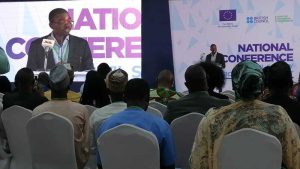
“Although the need for capacity improvement and enabling regulatory environment require attention to strengthen CSO operations in Nigeria, it is, however, expedient to address the concerns around the regulatory framework as several issues embedded therein need to be clarified to clear the air of the current state of confusion among all concerned stakeholders.”
In the meantime, over 1,000 virtual participants, drawn from representatives of CSOs, national and state-level regulatory agencies, development partners, donor community, private sector, opinion leaders, and other interest groups.
The conference is also supported by the European Union Delegation to Nigeria and West Africa and EU-Agents for Citizen-driven Transformation (ACT) Programme through a collaboration of EU-ACT Programme, Open Society Initiative for West Africa (OSIWA) and USAID-Strengthening Civic Advocacy and Local Engagement (SCALE) aimed at improving the civil society regulatory environment in Nigeria.
Share this


