

The call was made during a two-day engagement on Deepening CSO Self-Regulation and Understanding the Framework, organised under the Ethics and Good Leadership Awareness Initiative (EGLAI), with support from the EU-CSO Bridge Project implemented by the International Institute for Democracy and Electoral Assistance (International IDEA).
The engagement, held at Rockview Hotel, Abuja, from November 11 to 12, 2026, brought together representatives of CSOs from Niger, Kwara, Plateau, Benue, Nasarawa and Kogi states, as well as the Federal Capital Territory (FCT), to examine the framework, discuss its implementation and address concerns about accountability and organisational independence.
EGLAI Initiative Seeks Stronger Accountability Among CSOs
Speaking during the engagement, Mr. Harry Udoh said the self-regulation initiative was designed to empower state champions and CSOs to embrace the sector’s Code of Conduct, institutional self-assessment, working group coordination and improved information management systems.
He identified adherence to common standards, organisational accountability, transparency and improved coordination as essential elements of a credible and effective civil society sector.
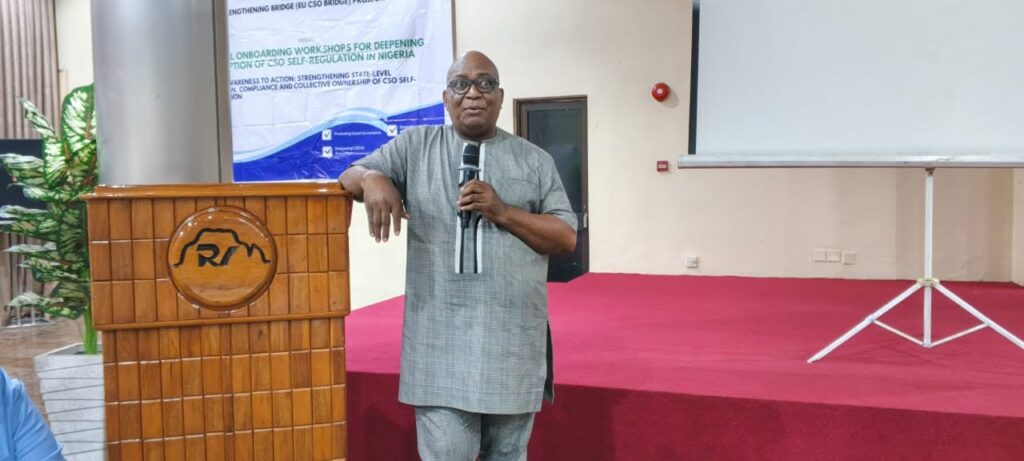
Udoh said effective self-regulation would demonstrate the commitment of CSOs to responsible institutional governance and accountability, particularly amid concerns about policies that could restrict civic space, including the proposed foreign aid bill.
He explained that the initiative was also intended to strengthen the capacity of civil society organisations to demonstrate that they could uphold acceptable standards without compromising their independence.
Udoh further disclosed plans to establish State Self-Regulation Committees beyond the North-Central region, extending the initiative to other states across the federation to coordinate and facilitate the implementation of the framework.
Organisers Outline Self-Regulation Framework, Institutional Standards
In her presentation, Elizabeth Okwori explained that CSO self-regulation was an institutional self-assessment process and did not replace formal registration with relevant government authorities.
She said the framework was designed to complement existing legal and institutional requirements by encouraging common standards, strengthening coordination and improving accountability practices across the civil society sector.
Okwori also identified the development of effective Management Information Systems (MIS) as an important component of the framework, noting that improved information management would support organisational assessment, coordination and institutional performance.
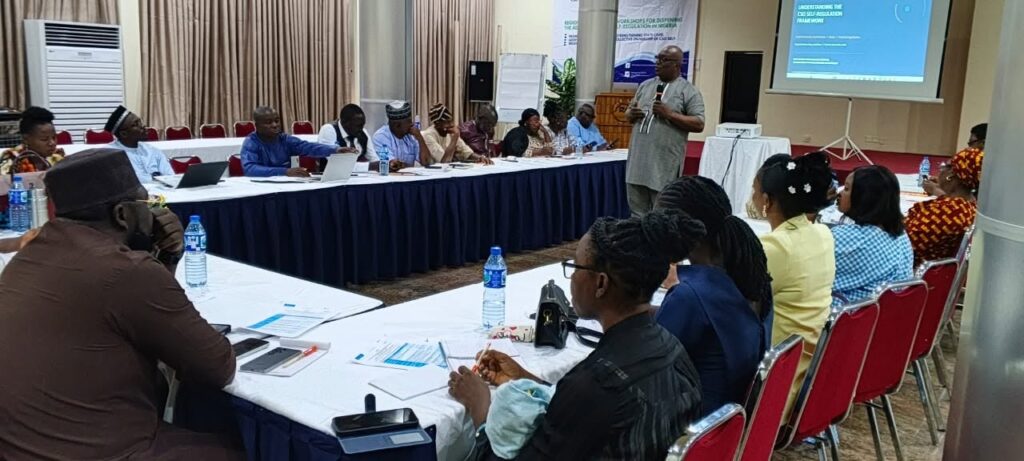
The framework is expected to provide CSOs with an opportunity to assess their internal operations, identify institutional weaknesses and strengthen their governance structures through established standards.
The organisers maintained that the process would help build a more accountable and coordinated civil society sector while encouraging organisations to take greater responsibility for their institutional practices.
Participants Raise Concerns Over Legal Framework, Civic Space
However, participants raised questions about the legal foundation of the self-regulation framework, the role of government in its implementation and the need to ensure that the process does not undermine the independence of civil society organisations.
They stressed that self-regulation must remain a CSO-driven accountability mechanism rather than become an additional instrument of government control or a means of restricting civic space.
Participants also called for the framework to recognise the different categories of CSOs, particularly organisations registered and operating at national, state and local government levels.
They argued that the implementation process must take into account the varying institutional capacities, operational realities and responsibilities of organisations across the country.
Another concern raised during the engagement was the need to strengthen community feedback mechanisms. Participants noted that institutional self-assessment and monitoring and evaluation processes should be complemented by direct feedback from communities and beneficiaries to establish whether organisations were meeting their objectives and making measurable impact.
CSOs Call for Inclusive Implementation, Community Participation
Participants recommended a clearly defined legal and institutional framework to guide the implementation of self-regulation, with well-established responsibilities for all relevant stakeholders.
They also called for stronger peer accountability mechanisms, improved information management systems and the integration of community participation into institutional assessment processes.
The participants maintained that the framework must be inclusive, transparent and responsive to the different operational realities of civil society organisations to encourage wider acceptance and effective implementation.
They further emphasised the importance of establishing safeguards that would prevent the process from being used to interfere with the activities or independence of CSOs.
The engagement concluded with a shared understanding that credible self-regulation could strengthen public confidence in civil society organisations, improve institutional performance and demonstrate their commitment to transparency and accountability.
The success of the framework, however, will depend on collective ownership by CSOs, effective implementation and adequate safeguards to preserve organisational independence and protect Nigeria’s civic space.


