As Nigeria prepares for the 2027 general elections, experts have warned that the country could face one of Africa’s most technologically advanced disinformation campaigns, driven by artificial intelligence and increasingly sophisticated digital manipulation tools capable of shaping public opinion and influencing electoral outcomes.
The warning was issued on Tuesday in Abuja by the Executive Director of the Centre for Media and Society (CEMESO), Akin Akingbulu, at a technical summit focused on strengthening fact-checking systems and improving media verification processes ahead of the polls.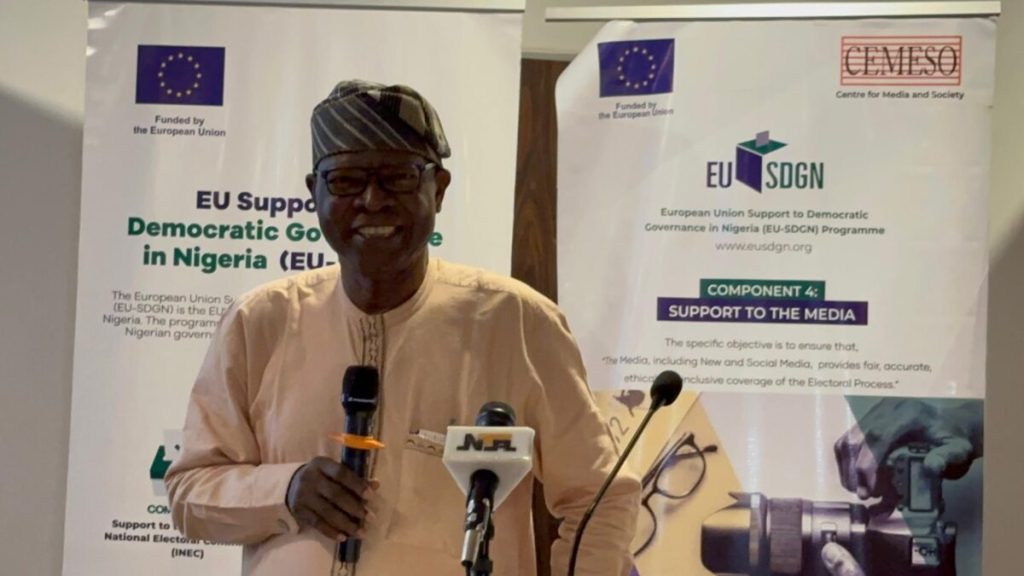
The event, themed “Mitigate Misinformation and Disinformation in the Electoral Process: Elevate Fact-Checking Capabilities of Journalists,” was held at the BON Octagon Hotel, bringing together journalists, media executives, and electoral stakeholders to examine emerging threats to information integrity in Nigeria’s democratic space.
Akingbulu warned that artificial intelligence has made it easier to generate convincing fake content, including deepfakes, cloned audio, and manipulated visuals, adding that Nigeria’s information ecosystem is increasingly vulnerable due to weak verification systems, low digital literacy, and limited capacity to detect sophisticated disinformation campaigns.
He called for urgent investment in fact-checking infrastructure, newsroom capacity building, and locally developed AI detection tools, stressing that without proactive measures, disinformation could further erode public trust, deepen political divisions, and undermine voter confidence ahead of the 2027 elections.
Growing Threat of AI-Driven Disinformation
Akingbulu warned that Nigeria’s information ecosystem is coming under increasing pressure from a combination of AI-generated misinformation, foreign interference, weak regulatory frameworks, and the continued exclusion of vulnerable groups from meaningful participation in political discourse.
He explained that these factors are already having visible consequences, including the erosion of public trust in democratic institutions, heightened political polarization, and the exposure of long-standing structural weaknesses within the country’s electoral and information systems.
According to him, the scale and sophistication of emerging threats suggest that the 2027 general elections could mark a turning point in the region’s information warfare landscape. “The 2027 elections will, in all likelihood, witness the most technologically complex disinformation campaign in African history,” he said.
He further noted that rapid advances in artificial intelligence have significantly lowered the technical barriers for creating highly convincing fake content, including deepfake videos and cloned audio recordings that mimic the voices and appearances of real public figures, making them increasingly difficult to detect and debunk.
Akingbulu added that global trends already point to the severity of the challenge, revealing that deepfake content worldwide increased by more than 500 percent between 2019 and 2023, a development he said underscores the urgent need for stronger verification systems, regulatory responses, and digital literacy across Nigeria’s media and political space.
Nigeria’s Rising Vulnerability to AI Disinformation
Akingbulu cited several emerging examples of AI-driven manipulation, including cases where videos generated using artificial intelligence falsely depicted international celebrities endorsing political candidates in Nigeria. He also referenced cloned audio recordings of political leaders that were deliberately circulated to mislead the public, provoke tension, and distort political narratives.
He further pointed to a synthetic video allegedly circulated in June 2025, which was reportedly designed to inflame existing tensions around the farmers–herders crisis in Benue State, warning that such content shows how digital tools are increasingly being weaponised in local conflict situations.
According to him, Nigeria’s vulnerability is worsened by the fact that most AI detection systems are primarily designed for English-language content, leaving widely spoken local languages such as Hausa, Yoruba, Igbo, and Nigerian Pidgin significantly under-protected and more susceptible to manipulation.
He also linked the spread of disinformation to declining civic engagement, noting that voter turnout in the 2023 general elections dropped to just 27 percent, a trend he warned could worsen if information disorder is not addressed.
“Youth are operating in a digital environment where 62 percent rely on social media as their primary source of political news, even as that same environment is being professionalised as a disinformation machine,” he said.
Growing Exposure and Local Risks
Akingbulu explained the growing real-world examples of AI-driven misinformation in Nigeria, including instances where AI-generated videos falsely portrayed international celebrities endorsing political candidates, as well as cloned audio recordings of political leaders that were deliberately used to spread misinformation, confusion, and political tension.
He also referenced a synthetic video allegedly circulated in June 2025, which was said to have been designed to escalate tensions around the farmers–herders crisis in Benue State, warning that such incidents demonstrate how emerging technologies are being weaponised in sensitive local conflicts.
According to him, Nigeria’s vulnerability is further compounded by the structure of global AI detection systems, which are largely built to analyse English-language content, thereby leaving widely spoken local languages such as Hausa, Yoruba, Igbo, and Nigerian Pidgin more exposed to manipulation and coordinated disinformation campaigns.
He linked this growing information disorder to declining democratic participation, noting that voter turnout in the 2023 general elections fell to 27 percent, a trend he warned could worsen if misinformation continues to undermine public trust in the electoral process.
“Youth are operating in a digital environment where 62 percent rely on social media as their primary source of political news, even as that same environment is being professionalised as a disinformation machine,” he said.
AI Fact-Checking Guide unveiled
As part of efforts to address the growing challenge of misinformation and disinformation, Akingbulu unveiled an AI Fact-Checking Guide developed to support journalists and editors in verifying information more efficiently, particularly under tight newsroom deadlines and the fast-paced nature of digital news dissemination.
He explained that the guide is designed as a practical verification tool that blends artificial intelligence with human editorial judgement, allowing journalists to cross-check claims faster while still maintaining accuracy, credibility, and ethical reporting standards in an increasingly complex information environment.
According to him, the goal is not to replace human verification but to strengthen it, ensuring that newsroom decisions remain grounded in editorial responsibility even as AI tools become more integrated into news production processes.
He also disclosed that CEMESO, through its platform haltfake.org, has established a coordinated fact-checking network across Nigeria and West Africa aimed at tracking, verifying, and countering false electoral narratives, including deepfakes, manipulated videos, and coordinated misinformation campaigns spreading across digital platforms.
Training Initiatives and Newsroom Challenges
Akingbulu disclosed that CEMESO has intensified capacity-building efforts for journalists as part of its response to the rising threat of misinformation, noting that over 100 journalists in Ekiti State were trained in collaboration with the International Press Centre, while an additional 80 journalists from Aso Radio and Television and the Federal Radio Corporation of Nigeria also underwent specialised training on fact-checking and verification techniques.
He said the trainings are aimed at improving newsroom preparedness, especially as digital manipulation tools become more advanced and harder to detect during election cycles.
Despite these efforts, he expressed concern that many Nigerian media organisations still lack dedicated fact-checking desks, a gap he said continues to weaken the overall verification capacity of newsrooms across the country.
Akingbulu therefore called for the institutionalisation of fact-checking as a core democratic safeguard, urging media owners, regulators, and civil society actors to support the development of AI-powered detection tools that can effectively analyse content in Nigerian languages and local contexts.
He also stressed the need for greater transparency in digital political communication, insisting that influencer marketing and coordinated online political campaigns should be properly regulated under existing campaign finance laws to ensure accountability ahead of the 2027 elections.
Campus Labs Initiative Gains EU Support
Akingbulu announced plans to establish Campus Newsroom Labs in tertiary institutions across Nigeria as part of efforts to strengthen media literacy, civic education, and electoral fact-checking skills among young and emerging journalists.
He said the initiative is designed to build a new generation of journalists equipped with practical tools to identify misinformation, verify digital content, and promote credible reporting in an increasingly complex information environment shaped by artificial intelligence.
He also commended the European Union for supporting the programme through its democratic governance initiative in Nigeria, noting that international partnerships remain crucial in strengthening media resilience and electoral integrity.
Akingbulu reaffirmed CEMESO’s commitment to working closely with media partners, fact-checking coalitions, and civil society organisations ahead of upcoming off-cycle elections, as well as in preparation for the 2027 general elections.
“The task ahead is formidable. The path is clear. And the moment to begin is not tomorrow. Today is the beginning of that work,” he said.
Share this