
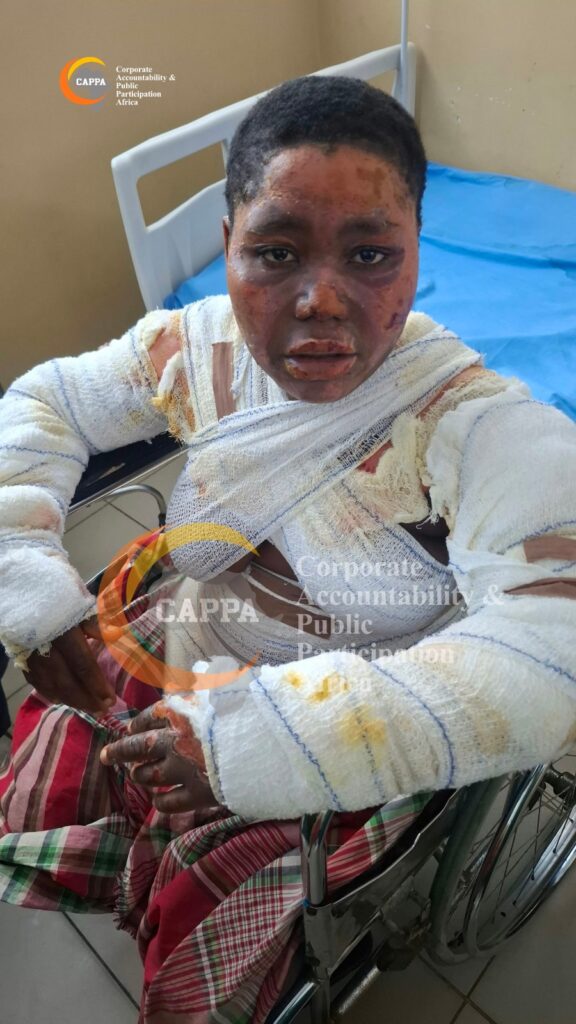
A 29-year-old woman, Joy Amos, who suffered severe burns in a gas explosion in her room in Bille, Rivers State, has died. Amos died on Tuesday, September 22, after she was moved from Bille to Port Harcourt for further treatment.
The Corporate Accountability and Public Participation Africa (CAPPA), in a statement signed by Robert Egbe, Media and Communications Officer, CAPPA, said her death had raised fresh concerns about the gas emissions reported in Bille Kingdom, Degema Local Government Area of the state.
The explosion occurred at about 8 a.m. on September 3 at No. 18, Opu Ibiila Community, where Amos lived.
CAPPA said the blast set part of the building on fire, shattered the windows and left Amos with extensive burns.
She initially received treatment at a private clinic in Bille for about nine days. According to CAPPA, her condition was reportedly improving before she was transferred to Port Harcourt on September 12.
The organisation said the transfer followed a call from a person identified by community members as Dr. Ndubisi Akpu, who reportedly said he was calling from the Ministry of Health and that the government would take over her treatment.
The community was informed on Tuesday that Amos had died, CAPPA said, adding that her remains were reportedly being taken to Ogoni for burial.
The organisation said the circumstances surrounding her death should be documented and independently investigated, including through an autopsy, considering the environmental conditions around the site of the explosion.
Gas still reported around explosion site
CAPPA said information it received indicated that the room where the explosion occurred was still producing an apparent gas-bubbling sound beneath the cemented floor, along with a noticeable gas-like odour.
The organisation said the incident was part of a wider gas-related problem reported in Bille since October 2025.
During a field visit on July 6, CAPPA said it observed gas emissions from wells, boreholes, residential compounds, waterways and school grounds.
It also said government investigations had reportedly found elevated levels of methane, hydrogen sulphide and carbon dioxide, as well as groundwater contamination and poor air quality.
CAPPA said residents were yet to receive a full explanation of the source of the emissions or a clear emergency response plan.
More incidents reported in Bille
The organisation also raised concern over other incidents recorded in the community.
“On September 12, Mrs. Tamunosiepribo Igani reportedly became dizzy and collapsed while walking to the waterside. She fell into a ditch and sustained a serious leg injury. As of September 22, she reportedly required transfer to Port Harcourt for specialist treatment.
Earlier on Tuesday morning, Ms. Deborah Adokiye Orlando, a teacher at State School One, Bille, reportedly collapsed while carrying out her duties.
Two separate household fires were also reported in August and September. In one incident, a fire reportedly broke out while Mrs. Damiete Akinda was attempting to light a mosquito coil. In another incident on September 7, a cooking fire reportedly spread through Mrs. Esther Dein’s home and destroyed substantial property,” CAPPA said.
CAPPA also said some residents had reportedly started collecting the emerging gas to power generators, while others were digging around their homes in search of gas outlets for domestic use.
It warned that such activities could expose residents to explosions, poisoning and other hazards.
The organisation linked the situation to the wider energy challenges facing communities in the Niger Delta, where residents continue to struggle with unreliable electricity despite the region’s importance to Nigeria’s oil and gas industry.
CAPPA demands government action
CAPPA’s Assistant Executive Director, Zikora Ibeh, said Amos’ death should push authorities to treat the situation in Bille as an emergency.
“Joy Amos did not have to die. Her death followed months of warnings, confirmed environmental hazards and repeated appeals for government intervention. Yet Bille still has no comprehensive emergency plan, no publicly identified coordinating authority and no clear timetable for containing the emissions. The government cannot continue to treat the lives of citizens as expendable,” Ibeh said.
CAPPA called on the Federal Government, Rivers State Government and relevant regulatory and emergency agencies to establish a coordinated response involving experts in environmental science, medicine, public health and emergency safety.
It also called for hazard mapping and the evacuation of households, schools and public facilities located in areas considered unsafe.
The organisation urged authorities to provide specialist treatment for Mrs. Igani, assess the teacher who reportedly collapsed and provide free medical screening for residents, particularly children, pregnant women and older people.
CAPPA further called for the immediate suspension of unsafe gas collection and use and the provision of alternative electricity and cooking energy for affected households.
It also demanded continuous air, water and soil testing, proper documentation of fires, explosions, illnesses and injuries, and the involvement of Bille residents in investigations and response measures.
The organisation said authorities should identify the institution coordinating the response and provide a timetable for investigations, medical intervention, social support and evacuation where necessary.
It added that once the source of the emissions was established, affected residents should receive remediation, compensation and legal accountability.
‘Nigeria is on the verge of a major national disaster’
CAPPA referred to its earlier documentary and report, Danger! Bille Is Highly Flammable, in which it warned that failure to address the gas emissions could lead to a major disaster.
Ibeh said:
“We would love to be proved wrong, but the reality is that human beings are living amid uncontrolled and deadly gas emissions. Nigeria is on the verge of a major national disaster, and Ms. Amos’s tragic death may only be the beginning of how much worse the situation could become if the authorities fail to act decisively.”
Share this