
By Michael Omotosho |
ANEEJ, Civil society organizations (CSOs), journalists, anti-corruption experts, and government institutions have called for stronger collaboration, evidence-based advocacy, and greater transparency to curb illicit financial flows (IFFs) in Nigeria.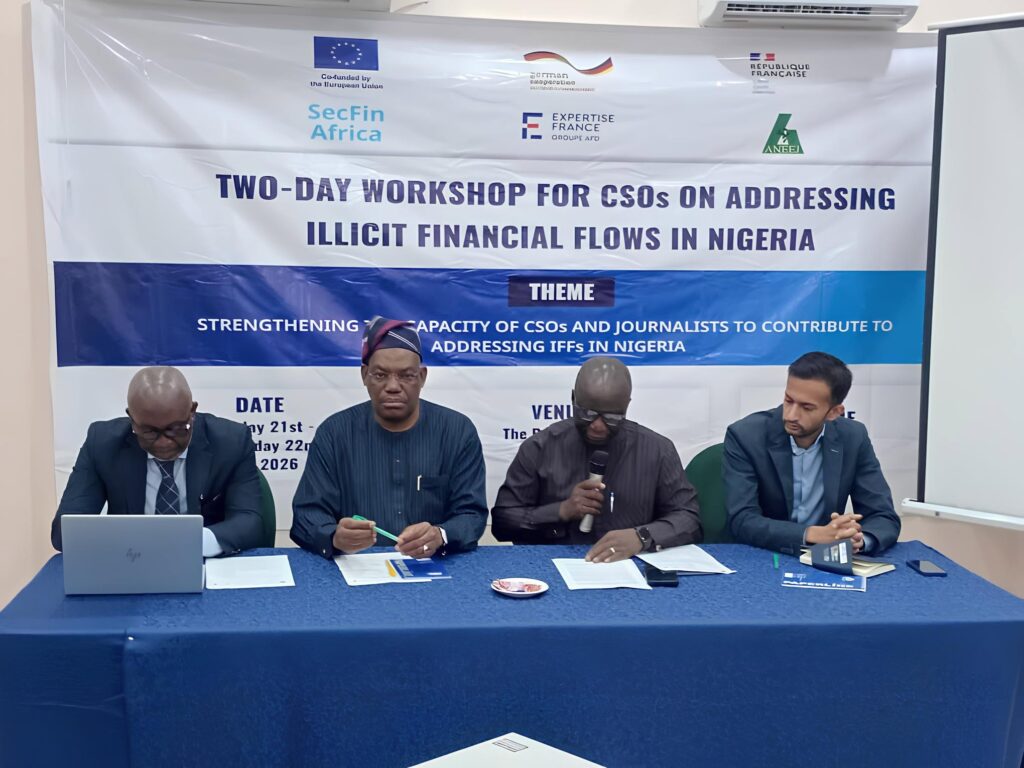
Organized by the Africa Network for Environment and Economic Justice (ANEEJ) under the theme, “Strengthening the Capacity of CSOs and Journalists to Contribute to Addressing Illicit Financial Flows (IFFs) in Nigeria,” the multi-stakeholder workshop highlighted the necessity of shifting away from fragmented individual efforts toward formidable, cross-sector coalitions capable of holding public and private institutions accountable.
The opening ceremony commenced with an address by David Ugolor, Executive Director of ANEEJ, who welcomed participants and set the vision for the engagement. This was followed by welcome remarks and goodwill messages delivered by Prof. Abdullahi Shehu, representative of SeCFin Africa, Mr. Chinedum Odenyi, who represented Hafsat Abubakar Bakari, Director and CEO of the Nigeria Financial Intelligence Unit (NFIU), and Jehanzeb Khan, Illicit Finance Adviser at the Deputy British High Commission.
Following the opening remarks, the workshop transitioned into an interactive session where participants, civil society representatives, grassroots network leaders, and media practitioners officially introduced themselves, shared their organizational mandates, outlined their expectations for the training, and completed a baseline pre-evaluation exercise managed by Innocent Edemhanria.
Reflecting on the history of grassroots organizing during his remarks, David Ugolor praised civil society networks that have sustained their watchdog presence despite institutional hurdles. “I am so happy, you know, just talking from the experience of having, in the past, lost the process of establishing a number of coalitions and networks for the past many years, and the experience that has come out of it, and to hear that Lagos State Coalition is still working… Ah! That must be commended,” Ugolor remarked.
He emphasized that unity remains civil society’s greatest leverage against systemic corruption, adding that “I just want to encourage you all that working in isolation is not helpful. It’s better to work in strong coalitions, that’s where it becomes very impactful. That’s one strength in our fight on anti-corruption that we have managed, and very effective,” while commending the NFIU for breaking traditional institutional barriers to engage directly with citizen groups.
Unpacking the Core Channels of Financial Leakages
Following the introductory sessions, the workshop dissected the structural mechanisms that enable capital flight out of developing economies. Leading the second session on understanding illicit financial flows in Nigeria, Prof. Abdullahi Shehu examined the core concepts, typologies, and development impacts of unrecorded capital flight, which deprives the nation of critical funding needed for healthcare, education, and social infrastructure. Shehu also delivered a dedicated presentation on the specific roles civil society organizations must play in combating these leakages.
Focusing on structural vulnerabilities, Mr. Aliu Mohammed Yusuf, former Director at the Economic and Financial Crimes Commission (EFCC), delivered two technical presentations during the third and fourth sessions. He analyzed key channels of financial diversion, including trade mis-invoicing, tax evasion, public procurement abuse, and extractive sector leakages. Yusuf further evaluated Nigeria’s legal and institutional frameworks, identifying critical legal gaps and enforcement bottlenecks that currently hinder effective prosecution and recovery.
Bridging the gap between regulators and public advocates, Mr. Chinedum Odenyi presented the statutory mandate of the NFIU as Nigeria’s central financial intelligence hub during the fifth session. Odenyi detailed how the unit functions and outlined clear entry points through which civil society organizations can submit credible financial intelligence and report suspicious capital movements.
Data-Driven Tracking, Field Safety, and Community Engagement
To transform public oversight into verifiable evidence, Engr. Adejoke Akinbode, Head of Research and Policy Advisory at the BudgIT Foundation, led sessions on accessing and using public data for accountability. She demonstrated how advocates can analyze the Freedom of Information (FOI) Act, state budget documents, the Nigeria Open Contracting Portal (NOCOPO), state audit reports, procurement datasets, and Beneficial Ownership Information to expose hidden conflicts of interest and track public funds accurately.
However, tracking public expenditures carries real-world risks. Highlighting the security threats faced by field researchers monitoring constituency projects, Akinbode recounted past incidents where personnel faced physical attacks and unjust detentions while carrying out field verification. To mitigate these risks, she stressed the absolute necessity of community diplomacy prior to field deployments, noting that “most times if you want to go on field work to track and check some projects, it’s very advisable that you speak with the community leaders first. Because if you go to some communities and they will not allow you to do anything without meeting their leaders first”.
Akinbode outlined a comprehensive methodology for evidence-based advocacy, urging practitioners to compile structured evidence lists with pictorial proof, engage the State House of Assembly Public Accounts Committee with their findings, collaborate with investigative journalists to write elaborate public reports, launch multi-channel awareness campaigns, and consistently monitor government commitments until abandoned projects are fully completed. She noted that public exposure remains one of the most effective tools for forcing government compliance, explaining that “a lot of times, when tell-tales call out government on projects… especially when the funds have been disbursed, you realize that give them two, three months, and you go back there, they’ve completed the projects. They do that a lot, and that shows that they listen… and they do not want people to attack them”.
Strategic Action Plans and Policy Recommendations
The practical phase of the event featured interactive group exercises where all participants, facilitated by the BudgIT Foundation, developed tailored CSO action plans for anti-IFF advocacy and engagement across two technical sessions. The event concluded with a comprehensive evaluation and closing remarks delivered by representatives of ANEEJ.
The deliberations yielded strong, concrete recommendations to overhaul Nigeria’s financial integrity framework. Stakeholders recommended full public access to beneficial ownership registries to unveil the real human owners behind anonymous shell companies winning government contracts. They called for institutionalized, periodic engagement channels between security agencies and civil society coalitions, alongside strict enforcement of open contracting standards across all tiers of government via the NOCOPO platform. Additionally, recommendations were made to establish physical and legal protection mechanisms for civil society field officers and journalists working in high-risk areas, while empowering local community leaders with practical skills to audit grassroots projects before final sign-offs.
Summarizing the overarching vision of the initiative, Akinbode emphasized that safeguarding national wealth requires collective responsibility, stating that “combating illicit financial flows is not solely the responsibility of government. It requires informed citizens, evidence-driven civil society, responsible media, accountable institutions, and strong partnerships working together to protect public resources and promote sustainable development”.
Share this