

By Esther Olaoluwa |
Journalists have been urged to strengthen investigative reporting as a critical tool for exposing illicit financial flows (IFFs), combating financial crimes and promoting accountability in Nigeria.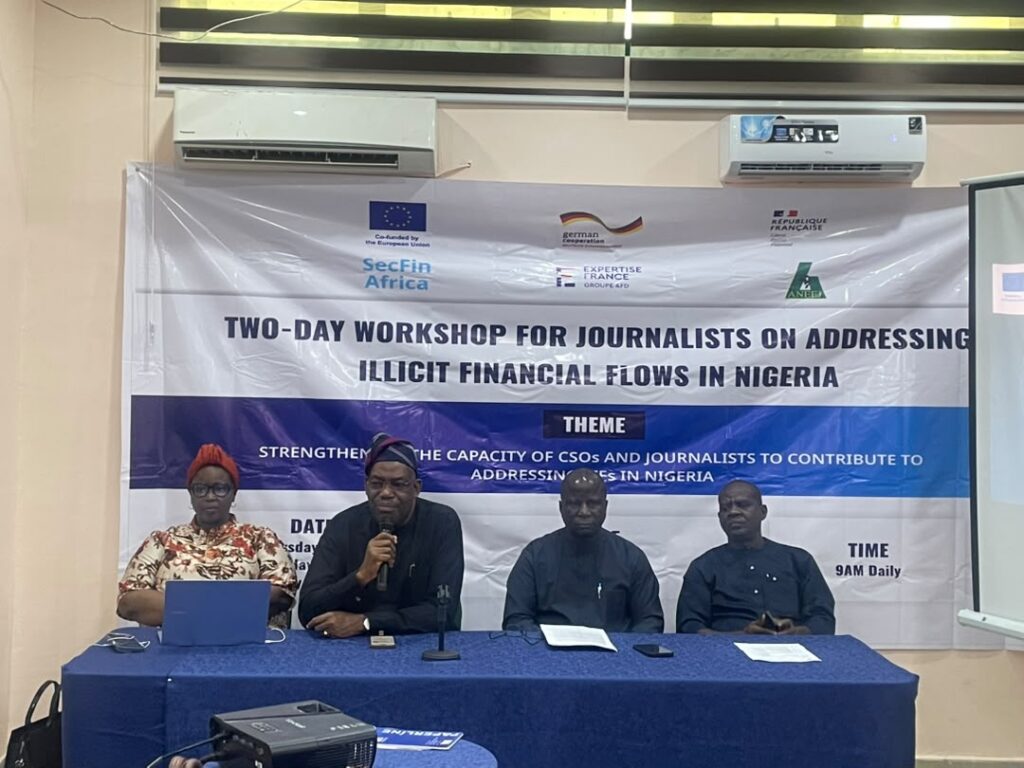
The call formed the focus of a two-day capacity-building workshop organised by the Africa Network for Environment and Economic Justice (ANEEJ), with support from the European Union through the SecFin Africa Programme and other partners. The workshop, themed “Strengthening CSOs and Media Capacity to Contribute to Addressing Illicit Financial Flows (IFFs) in Nigeria,” brought together journalists from print, broadcast and online media to deepen their understanding of illicit financial flows and strengthen their capacity to produce evidence-based, public-interest investigations.
The training sought to equip participants with practical knowledge on understanding illicit financial flows, reporting financial crimes, managing investigative risks and using journalism to strengthen transparency, accountability and democratic governance.
Media as a Catalyst for Accountability
Opening the workshop, Executive Director of ANEEJ, David Ugolor, challenged journalists to see investigative reporting as more than a professional responsibility, describing it as a vital public service capable of strengthening governance and protecting national resources.
He said journalists have a responsibility beyond reporting events, noting that the media helps citizens understand issues that affect their lives by uncovering illicit financial transactions, exposing corruption and holding public institutions accountable.
According to him, responsible journalism, backed by credible investigations and factual reporting, remains essential to ensuring that public resources are managed in the interest of Nigerians.
Understanding the Cost of Illicit Financial Flows
Setting the tone for the technical sessions, Prof. Abdullahi Shehu, Representative of the SecFin Africa Programme, provided participants with an overview of illicit financial flows and financial crimes in Nigeria.
He explained that illicit financial flows continue to undermine national development by depriving government of revenue required to fund education, healthcare, infrastructure and other critical public services.
Prof. Shehu identified corruption, tax evasion, trade mis-invoicing, money laundering and other illicit financial practices as major channels through which resources leave the country illegally, warning that the consequences extend beyond financial losses to include weakened institutions, slower economic growth and widening poverty.
He stressed that addressing illicit financial flows requires coordinated efforts among government institutions, regulatory agencies, civil society organisations, development partners and the media.
Strengthening Investigative Journalism
Moving from understanding illicit financial flows to examining the media’s role in addressing them, Taiwo Hassan of the Institute for Security Studies (ISS) challenged participants to rethink investigative journalism in Nigeria.
He described investigative reporting as one of the most effective tools for exposing corruption, financial crimes and governance failures that often remain hidden from public scrutiny.
Hassan encouraged journalists to move beyond routine event coverage by developing stories grounded in evidence, verification and public interest, stressing that impactful investigations require patience, persistence and a commitment to ethical journalism.
He also reminded participants that credibility remains a journalist’s strongest asset, urging them to prioritise accuracy and fairness while reporting complex financial issues.
Learning from Investigative Reporting
Providing practical newsroom perspectives, Musikilu Mojeed, Editor-in-Chief and Chief Operating Officer of Premium Times, shared case studies from investigative reports on corruption, financial crimes and illicit financial flows.
Drawing from years of newsroom experience, he demonstrated how persistence, collaboration, careful documentation and rigorous fact-checking have contributed to impactful investigations capable of influencing public discourse and strengthening institutional accountability.
He encouraged journalists to remain committed to public-interest reporting despite the challenges associated with investigative journalism, noting that evidence-based investigations can influence reforms and promote better governance.
Deepening the Media’s Contribution
Building on discussions from the first day, the workshop’s second day focused on strengthening the media’s contribution to addressing illicit financial flows.
Returning for another session, Prof. Abdullahi Shehu examined the role of the media in combating illicit financial flows, describing journalism as a strategic instrument for promoting transparency and accountability.
He said journalists have a responsibility to consistently produce reports that help citizens understand the broader implications of illicit financial flows on governance, economic development and public service delivery.
Prof. Shehu encouraged media practitioners to sustain investigative reporting capable of exposing financial crimes while contributing to informed public discourse and institutional reforms.
Examining Nigeria’s Legal and Institutional Framework
Former Director of the Economic and Financial Crimes Commission (EFCC), Aliyu Mohammed Yusuf, examined Nigeria’s legal and institutional framework for addressing illicit financial flows.
His presentation reviewed existing legal mechanisms and the responsibilities of institutions involved in tackling financial crimes, while highlighting the importance of effective implementation and stronger institutional coordination.
He also emphasised the need for sustained commitment to enforcing existing laws as part of broader efforts to curb illicit financial flows and strengthen accountability.
Understanding the Role of the NFIU
Also speaking, Aisha Bantam of the Nigeria Financial Intelligence Unit (NFIU) provided participants with an overview of the statutory mandate of the agency as Nigeria’s Financial Intelligence Unit.
She explained the NFIU’s responsibility for receiving, analysing and disseminating financial intelligence to relevant authorities, noting that the agency plays a central role in supporting investigations into suspicious financial transactions within Nigeria’s anti-money laundering framework.
Her presentation also provided journalists with a better understanding of the institution’s place within the country’s financial intelligence architecture and its contribution to combating illicit financial flows.
From Story Development to Investigative Planning
Further sessions facilitated by Taiwo Hassan focused on media framing, story development, reporting on illicit financial flows, media ethics, legal risks, protection of confidential sources and digital security in investigative journalism.
Participants were guided through practical approaches to identifying investigative story angles, managing reporting risks and developing stories that serve the public interest while maintaining professional and ethical standards.
The workshop also featured practical exercises where participants developed investigative story ideas around illicit financial flows and presented their reporting plans for peer review and professional feedback.
Advancing Public-Interest Journalism
Throughout the two-day engagement, facilitators consistently emphasised that tackling illicit financial flows requires sustained collaboration among journalists, anti-corruption institutions, development partners and other accountability actors.
They noted that while government agencies remain responsible for enforcing the law, the media has an equally important responsibility to investigate, inform and hold institutions accountable through factual, balanced and evidence-based reporting.
The workshop forms part of ongoing efforts by ANEEJ and its partners under the SecFin Africa Programme to strengthen media capacity and encourage investigative journalism that advances transparency, accountability and good governance in Nigeria.
Share this


