

As the Ekiti State governorship election unfolds, the democratic process has been heavily overshadowed by widespread allegations of vote-buying and voter inducement across multiple local government areas. Reports from field observers indicate a coordinated effort by political actors to influence voters with cash and slips, raising severe concerns about electoral transparency.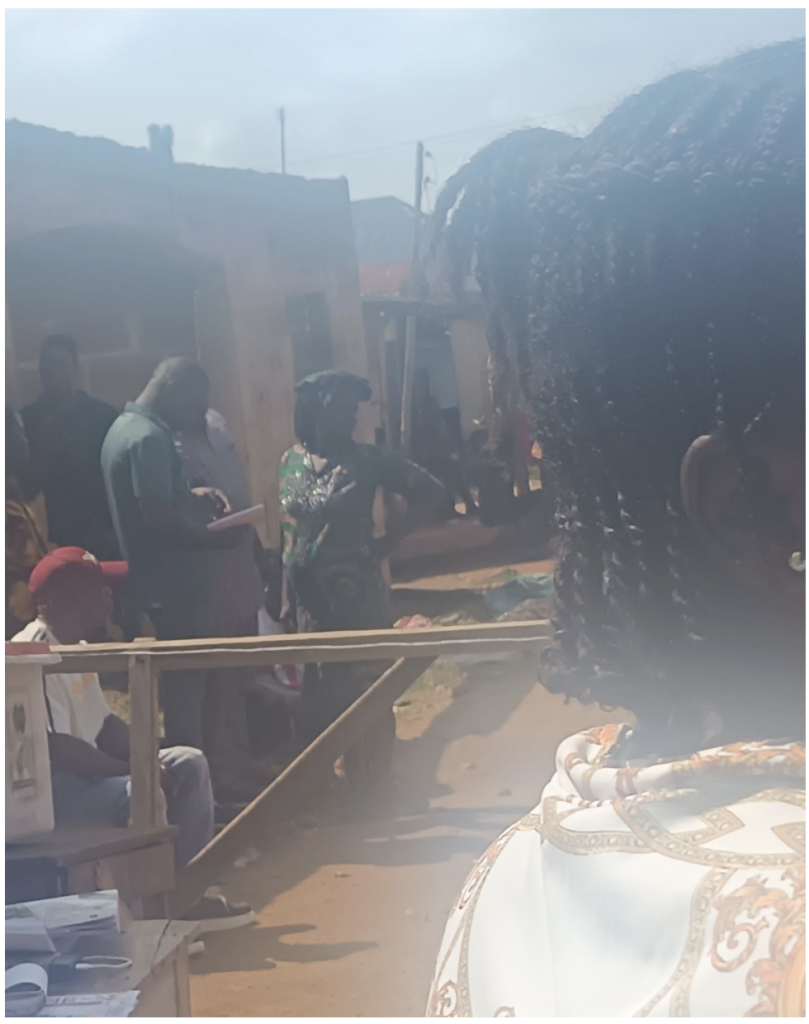
The Independent National Electoral Commission (INEC) explicitly classifies these activities as severe electoral offenses, yet monitors on the ground report flagrant violations of the law.
Cash-for-Votes Traced Across Multiple Wards
In Ado Local Government Area, field reporters captured distressing evidence of financial manipulation. At D’Ugbo Ward 4, Polling Unit 2, located at St. Michael Primary School, observers witnessed a political party agent actively recording voters’ personal details, including bank account numbers and phone numbers. According to witnesses, these details were collected alongside proof of voting in exchange for a promised payout of N10,000 per vote. A near-identical operation was flagged at the St. Michael’s Primary School polling unit in the Olubobokun compound, where voters were similarly tracked and promised N10,000 incentives.
Meanwhile, financial inducements were linked to other political camps early in the day. Separate intelligence from the field revealed that voters were being offered N5,000 to cast their ballots for the African Democratic Congress (ADC), proving that the machinery of voter inducement was not isolated to a single party.
Numbered Slips and Enclosed Pay-Out Zones
The All Progressives Congress (APC) faces heavy scrutiny following a flurry of reports regarding covert distribution systems. In Ilejemeje and Oye LGAs specifically at the Ilegbio polling unit observers watched APC agents intercepting citizens immediately after they exited the voting booths. The agents distributed small, numbered pieces of paper to the voters. While the exact operational purpose of these numbered tokens could not be independently verified by the time of publication, tracking systems of this nature are traditionally used as vouchers for off-site financial payouts.
Further corroborating this pattern, a makeshift distribution hub was uncovered in the Eleyowo market and Odoba Gidado areas. Monitors spotted APC party agents actively directing voters into an enclosed space to receive cash rewards. Similar incentive-sharing schemes were flagged by observers at Odo Emure 1, Iye, and the Peter Adesina store area.
Police Complicity and Candidate Harassment
The situation took a darker turn in Ekiti East LGA, where systemic corruption allegedly extended to security personnel. An observer stationed at St. Silas Primary School II, Egboigidi, within the Omu Oke 1 Ward, detailed a system where voters were escorted behind the polling booth to receive special identification numbers. The monitor raised an alarm over law enforcement bias, stating that “it would seem as though the police are in support of them… it looks like they are asking for theirs.”
The integrity of the election was further challenged by high-profile claims of violence and intimidation. Speaking to journalists after casting his ballot at Ward 2, Unit 4 in Ilawe Ekiti, Ekiti West LGA, the official ADC governorship candidate, Dare Bejide, expressed deep anger over the conduct of the election, detailing a direct assault on his convoy by a state official.
“I came here to vote as required by law. This is my polling booth,” Bejide told Channels TV in a live broadcast. “In the process, one political office holder, Makinde, came here with a fake policeman, pushed me, beat my driver to a stupor and harassed my security. They also brought in a large amount of money to share, and I told them that can’t happen here because today is election day, and that is what caused all this brouhaha. This is not his polling booth, and he has refused to leave.”
Electoral Act Violations Threaten Credibility
The unfolding irregularities in Ekiti East, Ido/Osi, Ijero, Ikere, and Ado LGAs constitute a direct breach of national law. Under Nigeria’s Electoral Act, vote-buying, financial inducement, and any form of political campaigning on election day are strictly prohibited. Legal penalties for these violations range from heavy statutory fines to mandatory imprisonment. Despite these legal safeguards, the pervasive use of tracking identifiers, account detail logging, and physical intimidation across Ekiti State continues to threaten the credibility of the 2026 gubernatorial outcome.
Share this


