

By Michael Omotosho |
Crimes that affect the environment are no longer just a conservation crisis they have rapidly evolved into a sophisticated national security threat. Speaking at the first-ever United Nations General Assembly high-level debate dedicated to environmental crimes, Monica Juma, Executive Director of the United Nations Office on Drugs and Crime (UNODC), warned global leaders that criminal networks are weaponizing natural resources to fund wider illicit operations.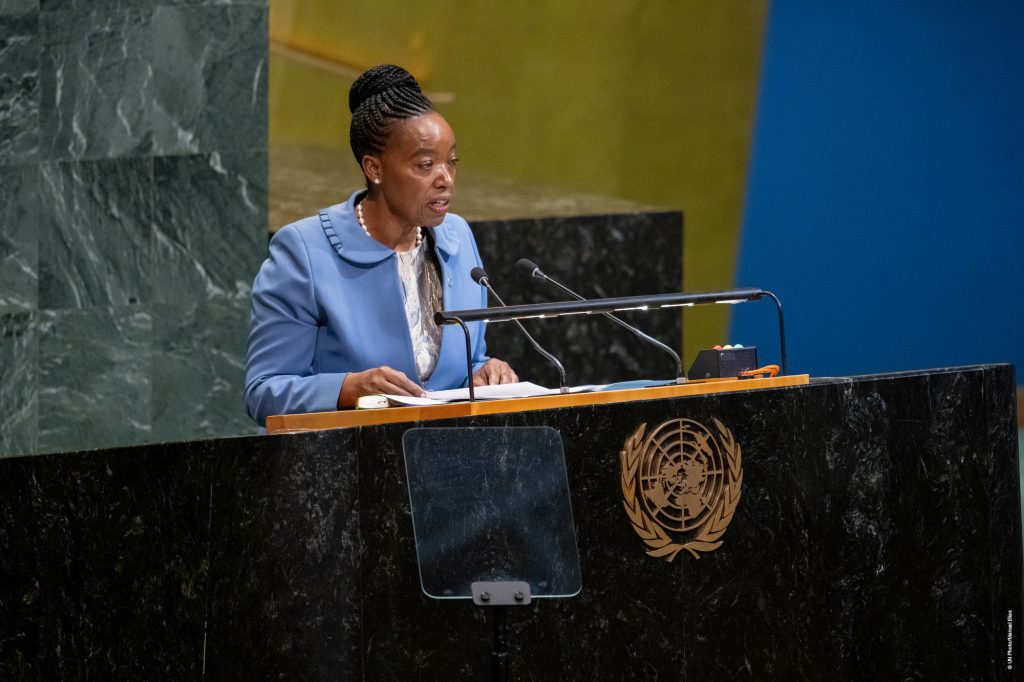
“For too long, these crimes were viewed primarily through a conservation lens. But that framing is no longer sufficient. Crimes that affect the environment are a rapidly evolving form of transnational organized crime that is exploiting natural resources, weakening institutions, and generating illicit profits on a global scale,” Ms. Juma told the Assembly.
The high-level debate, convened on Monday, 8 June, highlighted how resource exploitation strips states of their territorial sovereignty, devalues legitimate economies, and actively threatens the safety of citizens. Underscoring this reality, the President of the General Assembly, H.E. Annalena Baerbock, reminded delegates that the sweeping impact of these activities serves as a stark reminder that environmental offenses compromise the very infrastructure of modern societies, institutions, and global economies.
A Single Criminal Business Model Across Borders
According to findings presented at the debate, the syndicates responsible for illegal logging, wildlife trafficking, and illicit mining are rarely specialists; instead, they utilize the same supply chains, personnel, and money laundering channels that service other severe global vices. Cartels are increasingly diversifying their portfolios by pairing environmental devastation with human trafficking for forced labor, arms smuggling, and drug trafficking.
“Different commodities, different markets, but the same criminal business model. These threats represent the commodification of nature by organized crime. They generate billions of dollars in illicit profits each year, fuelling corruption and money laundering, while distorting trade and legitimate economies,” Ms. Juma underscored.
This multi-commodity criminality is already operationalizing across vulnerable ecosystems worldwide. In the Amazon Basin, criminal factions are devastating rainforests, poisoning vital waterways, and aggressively challenging state authority via illegal gold mining and logging. Simultaneously, environmental crimes are inextricably intertwined with the narcotics economy in the Golden Triangle, while across the Sahel region, illicitly extracted diamonds and gold actively finance heavily armed insurgencies and dismantle local governance.
Bridging Conservation Science and Criminal Justice
To counteract these expanding networks, the UNODC, alongside Monica Juma and Grethel Aguilar of the International Union for Conservation of Nature (IUCN), announced the launch of a strategic partnership designed to bridge the gap between conservation science and criminal justice. This alliance aims to dismantle transnational criminal structures by applying rigorous scientific tracking alongside cross-border prosecution strategies.
The international community currently maintains three robust legal pillars to combat this syndication: the UN Convention against Transnational Organized Crime (UNTOC) for mutual legal assistance, the UN Convention against Corruption (UNCAC) to sever the bribery that enables eco-crimes, and the newly established UN Convention against Cybercrime, which facilitates the rapid sharing of electronic evidence.
“We have a robust international legal framework at our disposal. Yet this framework is only as strong as the justice systems that enforce it,” Ms. Juma noted.
As the guardian of these treaties, the UNODC is actively fortifying front-line defenses. In 2025 alone, the office backed more than 80 cross-border investigations and facilitated law enforcement operations spanning 59 countries, culminating in over 200 significant timber and wildlife seizures.
Exploited Vulnerabilities and Gaps in Enforcement
Despite the legal infrastructure available, major loopholes continue to protect high-level environmental criminals. A primary vulnerability is the systemic failure of many jurisdictions to classify environmental offenses as “serious crimes” under UNTOC definitions, which legally restricts international intelligence sharing and advanced investigative methods.
Data from the UNODC’s Global Analysis of Crimes that Affect the Environment reveals a glaring disparity in global justice: while 86 percent of Member States have officially criminalized wildlife offenses, less than half impose penalties meeting the four-year imprisonment threshold required to trigger deep international legal cooperation.
“In other words, the legal architecture is largely in place, but it is unevenly applied. And it is precisely these gaps and vulnerabilities that criminal networks exploit and which we must strive to close,” Ms. Juma said.
To seal these gaps, the UNODC laid out a series of core mandates for Member States, including a massive surge in data-sharing regarding illegal fishing and waste crimes, and deep private-sector integration to ensure global supply chains are insulated against illicit products. Above all, financial investigations must become standard practice.
“Follow the money. Every shipment of illegally harvested timber, every trafficked wildlife product, every illicit mineral transaction generates a financial trail that can expose criminal networks, corrupt facilitators and the beneficiaries behind these crimes,” Ms. Juma stressed.
A Collective Responsibility for Future Generations
As the debate concluded, world leaders were challenged to pivot from rhetorical condemnation to operational execution. General Assembly President Annalena Baerbock urged delegates not to simply diagnose the problem, but to identify practical ways forward to strengthen cooperation, maximize existing mechanisms, and build a unified, collective response.
The session closed with a unified call to view environmental preservation as an extension of global peace and security. Reflecting on the desired impact of the assembly, Ms. Juma emphasized that a stronger, more coordinated global response remains the only viable path to protecting the planet’s natural treasures for the benefit of humanity today and the generations to come.
Share this


