

The Technologies for African Agricultural Transformation (TAAT) Programme has trained 100 agricultural extension experts from seven North-West states to improve farmers’ access to agricultural technologies and innovations.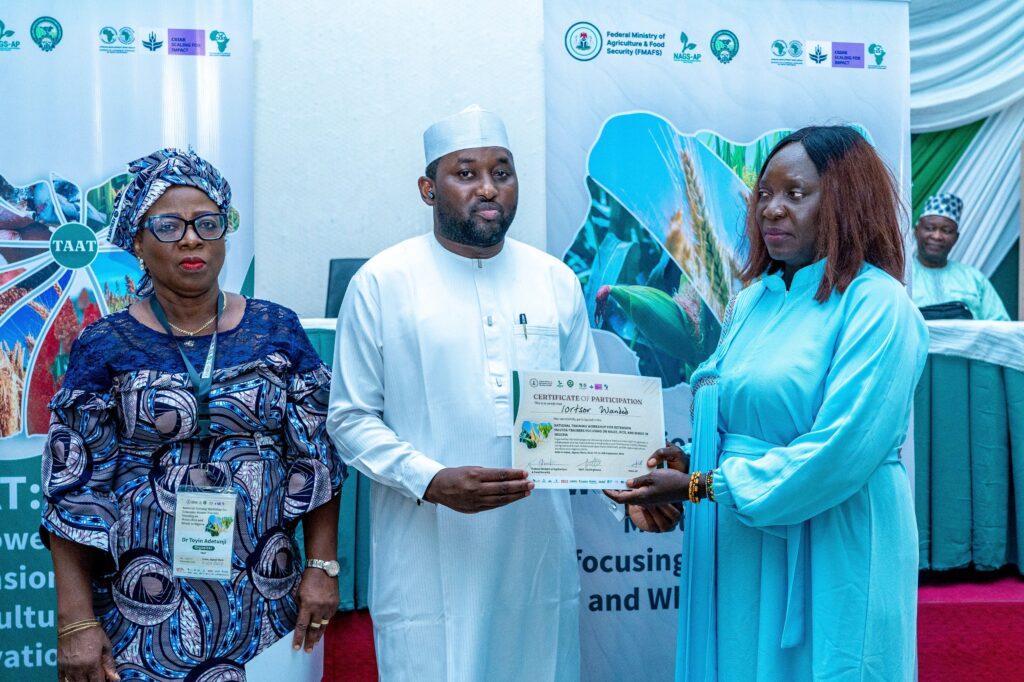
The five-day training, held from September 7 to 11, 2026, in Dutse, Jigawa State, was organised under the theme, “Empowering Extension to Scale Agricultural Innovations.”
Participants came from Jigawa, Kaduna, Kano, Katsina, Kebbi, Sokoto and Zamfara states.
The training focused on strengthening the skills of extension workers who are expected to take agricultural technologies and knowledge to farmers in their respective states.
Reaching Farmers
Speaking at the closing ceremony, Dr Saifullahi Umar, Director General of the Jigawa Agricultural Transformation Agency, who represented the state governor, said the success of the training would depend on what happens after the participants return to their communities.
“The real measure of this training will be the impact it has at the farm level.”
Umar said the trained experts are expected to help reach 500,000 farmers across the North-West as they share the knowledge gained during the training with other extension workers and farmers.
The programme is coming at a time when Nigeria’s agricultural extension system continues to face challenges, including limited personnel, funding and logistics.
Taking Innovation to Farms
According to Dr Solomon Gizaw, Head of the TAAT Clearinghouse, having agricultural technologies is not enough if farmers cannot access them.
“The success of TAAT’s technology delivery model depends not only on the technologies themselves, but also on the people and institutions that take these innovations to farmers.”
The training brought together several organisations, including TAAT, the CGIAR Scaling for Impact Programme, Federal Ministry of Agriculture and Food Security, National Agricultural Growth and Agro-Pocket Programme (NAGS-AP), Sasakawa Africa Association, Lake Chad Research Institute, Nigerian Cereals Research Institute, Institute of Agricultural Research (Zaria), and AfricaRice.
The initiative also supports broader efforts to improve farmers’ access to technology, inputs and agricultural advisory services through programmes including the African Development Bank’s $1.5 billion African Emergency Food Production Facility and Nigeria’s NAGS-AP.
Trainers to Cascade Knowledge
One of the participants, Mallam Abubakar Danmaliki Mohammed, a master trainer from Sokoto State, said the participants now have a responsibility to take the lessons from the training to farmers.
“Our responsibility now is to use the knowledge and experience we have gained to transform last-mile delivery in Nigeria,” he said.
“We must ensure that farmers are not left behind.”
The 100 trainers are expected to return to their respective states and share the training with other extension workers, helping to extend its reach to farming communities across the North-West.
Share this


