
The European Union Support to Democratic Governance in Nigeria Election Observation Hub (EU-SDGN EOH) has raised concerns over vote buying, political violence and transparency in results management ahead of Saturday’s Osun State governorship election.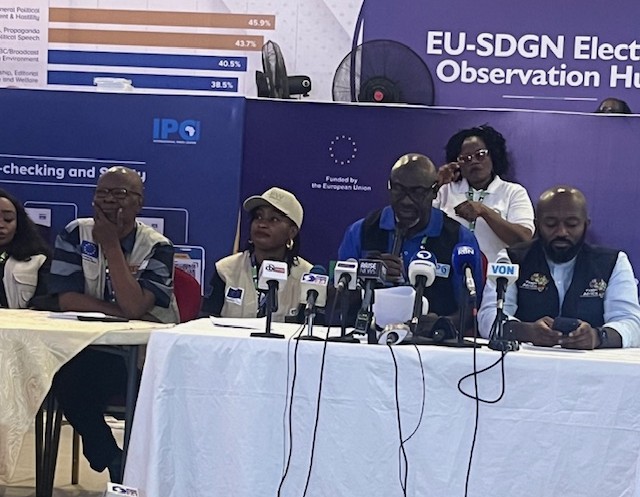
The warning came on Friday, a day before voters across the state are expected to elect a governor, as the International Press Centre (IPC) unveiled a new WhatsApp-based platform to help journalists report attacks and other incidents during the election.
The EU-backed observation hub said it would deploy 843 observers across Osun’s 30 local government areas to monitor the poll.
The Independent National Electoral Commission (INEC) has scheduled the election for August 15, 2026, with 14 political parties participating. A total of 2,339,233 registered voters are expected to vote across 3,763 polling units.
The election is being closely watched as one of Nigeria’s major electoral tests ahead of the 2027 general elections, particularly with recent changes to the country’s electoral laws introducing new requirements around electronic transmission and management of results.
Vote Buying Raises Concern
The EU-SDGN EOH identified vote buying and voter inducement as the biggest threat to the credibility of the election.
The observers said reports of financial and material inducements had emerged during the campaign period, although they did not provide details of specific incidents in their briefing.
They urged relevant authorities to investigate and prosecute those involved in vote buying, rather than relying solely on public warnings.
The observers also warned about misinformation and inflammatory political messages, particularly across social media platforms.
They called on journalists and civil society organisations to verify information before publication and adopt conflict-sensitive reporting to prevent false claims from worsening tensions.
Security Remains a Major Risk
The observation hub classified the overall security environment in Osun as high risk, with two local government areas rated critical risk, 11 high risk and 17 moderate or low risk.
It cited concerns including political violence, disputes over local government control, criminal activity and misinformation.
The observers also referred to reports of attacks on political figures and offices, shootings, abductions and violence linked to campaign activities.
Concerns were equally raised over allegations of police brutality, illegal arrests, excessive use of force and extrajudicial killings.
The hub, however, presented these as issues requiring attention rather than established findings from Saturday’s election.
It urged security agencies to remain neutral and professional, stressing that their conduct could significantly affect public confidence in the electoral process.
The Nigeria Police Force is expected to lead election security operations, with support from the military and other agencies under the Inter-Agency Consultative Committee on Election Security.
INEC Assures Voters of Readiness
INEC has maintained that it is ready to conduct the election across the state.
At a stakeholders’ meeting in Osogbo in July, INEC Chairman Joash Amupitan said the commission had completed the voter register and was prepared for voting across Osun’s 30 local government areas, 332 registration areas and 3,763 polling units.
The commission also established 97 Super Registration Area Centres and 105 Registration Area Centres to support the deployment of personnel and election materials.
Earlier preparations provided for 4,427 BVAS devices, including 664 backup units.
The EU-SDGN briefing, however, said the number had been increased to 5,130 BVAS devices, including 1,367 backups, following a mock accreditation exercise.
The observers said the August 1 mock exercise exposed challenges with some BVAS devices recognising voters’ biometric information, although INEC later reported that the issues had been resolved.
Electronic Results Transmission Under Watch
Another major concern raised by the observers is the electronic transmission and publication of election results.
Section 60(3) of the Electoral Act 2026 requires presiding officers to electronically transmit polling-unit results to INEC’s Result Viewing Portal, known as IReV.
Where electronic transmission fails because of communication problems, the signed physical Form EC8A remains the primary document for collation and declaration.
The observers, however, questioned the introduction of an additional electronic result form or validation process, saying the procedure had not been sufficiently explained to the public.
They said voters should understand how results move from polling units to the final declaration, including what happens when electronically transmitted results differ from physical result sheets.
The group also criticised the current publication of results on IReV, arguing that the portal does not provide citizens with a complete picture of results at every stage of the collation process.
The concern is significant because electronic results have become an important tool for journalists, observers and citizens seeking to independently track election results.
With the new Electoral Act giving electronic transmission a clearer statutory basis, the observers said the process must be both technically reliable and transparent to the public.
Inclusion of Women, Youth and Persons With Disabilities
The observers also raised concerns about the participation of women, young people and persons with disabilities in the electoral process.
They urged INEC, political parties, security agencies and civil society organisations to remove practical barriers that could prevent vulnerable groups from voting.
Among the concerns highlighted were transportation difficulties and inadequate access to assistive devices.
INEC has previously announced measures including Braille ballot guides, magnifying glasses and priority access for persons with disabilities and other vulnerable voters.
The observers noted that the effectiveness of these measures would ultimately depend on whether eligible voters could access them at polling units on election day.
IPC Launches Journalist Incident-Reporting Platform
Meanwhile, the International Press Centre has introduced a pilot technology platform, WAFLO, to help journalists report attacks and other incidents during the Osun election.
IPC Executive Director Lanre Arogundade said the WhatsApp-based system would allow journalists to report incidents involving assaults, threats and other restrictions on media freedom.
According to him, the platform would later be expanded for use during the 2027 general elections.
The centre also advised journalists covering the election to carry their accreditation documents, identification cards and professional credentials.
It called on security agencies to respect journalists’ right to report from polling units and collation centres.
The platform is expected to provide a quicker record of incidents involving journalists, although its impact will depend on the speed of verification and response to reported cases.
Journalists can access the reporting channel through the SafeMedia WhatsApp prompt @ https://dub.sh/safemedia or by typing ‘safemedia’ to:
Voters Head to Polls Saturday
Voters across Osun will go to the polls on Saturday, August 15, with polling expected across all 30 local government areas.
The EU-backed observers urged political parties and candidates to respect the peace agreement signed ahead of the election and to pursue legal channels where disputes arise rather than resorting to violence.
For voters, the key test will be whether they can cast their ballots freely and follow the process from voting to counting and final declaration.
The outcome of the election will therefore depend not only on INEC but also on the conduct of political parties, security agencies, voters, journalists and technology providers.
With the 2027 general elections approaching, the handling of the Osun poll could provide an important indication of Nigeria’s progress towards a more transparent, peaceful and credible electoral process.
Share this


