

By: Peter Emmanuel |
The National Information Technology Development Agency (NITDA) has urged the Central Bank of Nigeria (CBN) and financial institutions to adopt artificial intelligence and other supervisory technologies to strengthen risk detection and regulation as Nigeria’s financial ecosystem becomes increasingly digital.
The Director-General of NITDA, Kashifu Inuwa, made the call while delivering a keynote address at the CBN Committee of Departmental Directors’ Retreat in Lagos, where he spoke on digital transformation and supervisory innovation.
Inuwa said the rapid growth of digital finance has changed the way financial services operate, making it necessary for regulators to move beyond traditional approaches to supervision.
He pointed to the roughly N1.07 quadrillion in electronic payment transactions recorded in 2024, noting that modern banking now extends beyond physical branches to mobile applications, cloud infrastructure, third-party service providers and continuous data streams.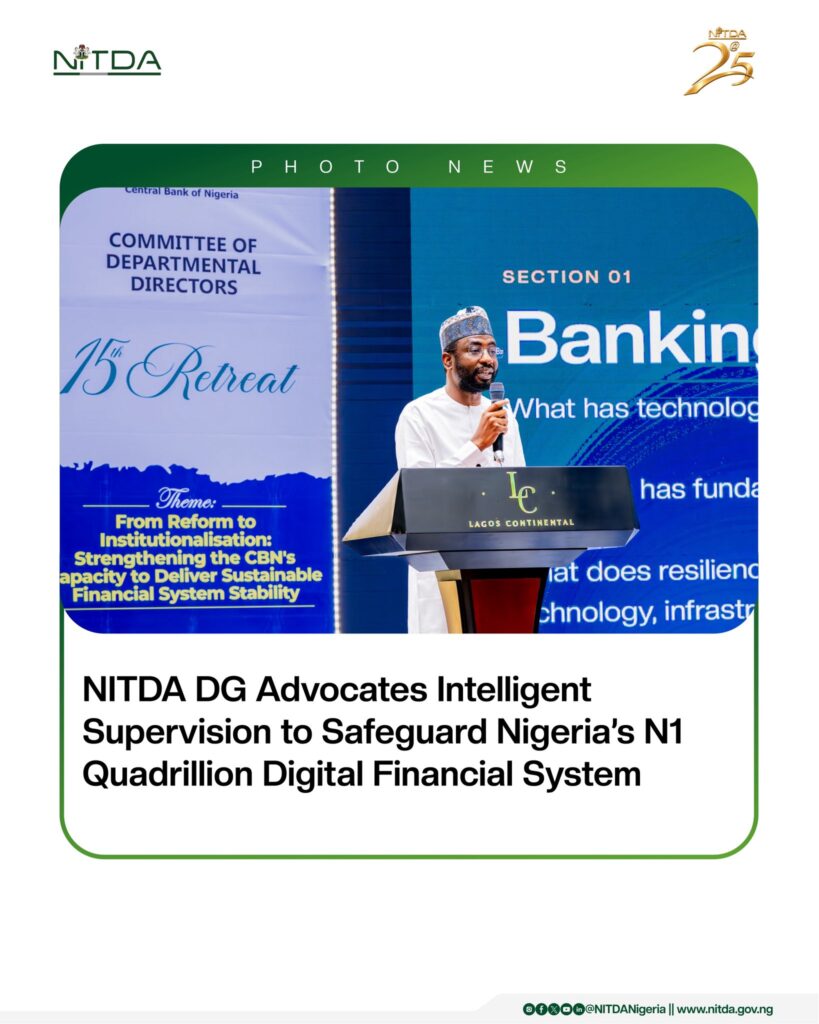
According to him, the growing complexity of the financial ecosystem requires regulators to become more data-driven, agile and proactive in identifying emerging risks and maintaining public trust.
NITDA DG Calls for Real-Time Data to Strengthen Financial Oversight
Inuwa said regulators could no longer rely mainly on traditional periodic reporting to monitor developments in the financial sector.
He called for the use of real-time data flows, complete-population analytics and early-warning indicators to help regulators identify vulnerabilities before they develop into wider disruptions.
He said access to timely and comprehensive data would enable regulators to have a clearer picture of developments across the financial ecosystem and respond more quickly to emerging threats.
Inuwa also encouraged financial sector regulators to make greater use of artificial intelligence and other advanced technologies to improve supervisory processes and strengthen their ability to detect risks.
He, however, stressed that the use of AI should complement the work of regulators rather than remove human judgment from the supervisory process.
According to him, technology should serve as a tool to support better decisions, while human expertise and judgment remain important in assessing complex financial risks.
Inuwa Urges Regulators to Map Digital Dependencies, Strengthen Resilience
The NITDA DG also stressed the need for regulators to pay closer attention to the third-party infrastructure on which financial institutions depend.
He noted that banks and other financial service providers increasingly rely on telecom networks, cloud hosting services and external payment switches to deliver services to customers.
Inuwa said regulators must map these connections and understand the potential risks that could arise from disruptions affecting critical third-party providers.
He explained that a failure in one part of the digital infrastructure could have wider consequences for financial services if the dependencies are not properly identified and managed.
The NITDA DG therefore called for greater attention to operational resilience to ensure that essential financial services remain available even when networks, systems or other supporting infrastructure experience disruptions.
He said the increasing integration of Nigeria’s financial systems makes systemic resilience a responsibility that must be continuously reviewed and strengthened by regulators and industry stakeholders.
Inuwa concluded that as the country’s financial ecosystem continues to digitise, regulatory oversight must also evolve to become more data-driven, agile and proactive in managing emerging risks and protecting public confidence.
NITDA Urges CBN, Financial Institutions to Adopt AI for Smarter Risk Detection
Share this