
By Michael Omotosho |
In a strategic move to eliminate preventable deaths and ensure universal health coverage for all residents, the Lagos State Health Management Agency (LASHMA) has concluded a two-day intensive capacity-building workshop for journalists in Lagos.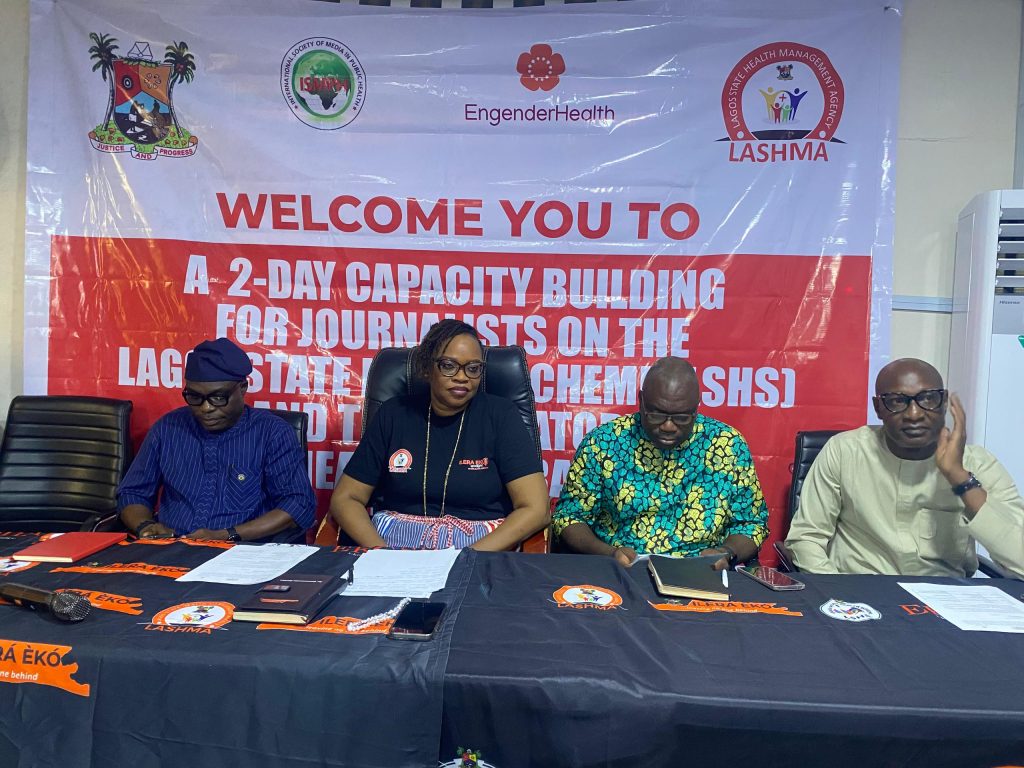
The program, organized in collaboration with the International Society of Media for Public Health (ISMPH) and the EngenderHealth consortium, focused on the Lagos State Health Scheme (LSHS) and the mandatory social health insurance plan, popularly known as Ilera Eko.
Prioritizing Lives Over Profit
The workshop aimed to equip media professionals with the tools to navigate the complexities of health insurance reporting, ensuring the public is well-informed about their rights and the benefits of the scheme.
In her keynote address, the Permanent Secretary of LASHMA, Dr. Emmanuella Zamba, underscored that health insurance is now a legal mandate for all Lagosians, rather than a matter of choice.
Addressing the press, she highlighted the media’s indispensable role in fostering public trust and accountability within the healthcare sector. Dr. Zamba expressed deep gratitude to partners ISMPH and EngenderHealth, noting that the workshop was the fulfillment of a personal promise she made during a national media dialogue in Abuja last year.
“I made a personal commitment that LASHMA would prioritize capacity building for journalists as critical partners in advancing health insurance awareness,” she stated. Emphasizing that the collaboration reflects a shared mission to strengthen the state’s health systems.
Mr. Kayode Oyekanmi, Director of the Strategic Centre at the Ministry of Information and Strategy, during his opening remarks said, “there is nothing more worthy than preserving lives,” he stated. “As media organizations, you must be the worthy ambassadors of Ilera Eko. When we talk about social health care, we are talking about adding value to life itself.”
Follow the Money, Follow the Policy
Executive Director of ISMPH, Chief Mrs. Moji Makanjuola, during her goodwill message, urged journalists to look beyond surface-level statistics and focus on investigative, solution-based reporting. She highlighted the media’s power to hold institutions accountable.
“Your reporting informs public understanding and influences policy priorities,” Makanjuola said. “By strengthening your capacity, you are equipped to follow the money, follow the policy, and follow the human resources. This capacity building is a call to action to amplify the voices of the vulnerable and sustain public dialogue on health solutions.”
Supporting this sentiment, Mr. Solomon Dogo, Program Director of ISMPH, noted that the overarching goal is to reduce mortality rates in Lagos by helping communities access LASHMA’s affordable services. He called for a robust, sustainable relationship between the agency and the press.
Increased Funding and Enforcement
Dr. Zamba revealed that the Lagos State Government has demonstrated its commitment by increasing the Equity Fund dedicated to providing coverage for the vulnerable from ₦1 billion to ₦3 billion. This fund is supported by 1% of the state’s Consolidated Revenue Fund.
“Despite these efforts and the introduction of innovations to simplify enrollment, there is still a need for sustained awareness,” Dr. Zamba noted. She explained that enforcement has already commenced across various Ministries, Departments, and Agencies (MDAs) following the executive order signed by Governor Babajide Sanwo-Olu in July 2024.
Ethical Reporting
The workshop also featured sessions on ethical reporting led by Mr. Boniface Kassam (ISMPH), who reminded participants that health stories require more sensitivity than political ones.
“Health stories involve sensitivities; misrepresenting a patient is a serious matter,” Kassam warned. “We must humanize statistics. Our goal is to build public trust so that residents no longer view health insurance as a ‘scam’ but as a transparent, life-saving tool.”
Representatives from LASHMA, Mr. Lanre Green and Mrs. Peace Kukoyi, further educated the press on the “Customer Journey,” explaining the process from, registration and payment to the activation of care and plans. They emphasized that for civil servants, deductions are automatic, while for the informal sector, payment is the key to unlocking access to quality, high-end medical procedures like surgeries at a fraction of the out-of-pocket cost.
The program, supported by the Gates Foundation, concluded with a commitment from the media to increase coverage and transparency, ensuring that health remains a top priority on the state’s developmental agenda.
Share this


