
In Lagos political calculations, Surulere Constituency I has long functioned as more than a legislative district. It is a political stronghold where influence is not merely contested at election cycles but continuously negotiated through layered networks of loyalty, campaign history, and elite alignment.
Ahead of the 2027 elections, that internal architecture is once again under subtle but significant strain, not through open rebellion but through gradual repositioning within the constituency’s established power structure.
The emergence of Hon. (Barr.) Barakat Odunuga-Bakare is increasingly being read within APC circles not as an isolated ambition, but as part of a broader recalibration of influence within Surulere’s political order — one shaped by long-standing campaign structures, executive appointments, and evolving internal loyalties.
Her January 1, 2026 declaration did not introduce a new political actor. Instead, it formalised a trajectory already embedded within the constituency’s political machinery, spanning ward-level governance, state executive administration, and campaign coordination at the highest levels of Lagos APC mobilisation.
In that sense, her candidacy is being interpreted less as disruption and more as continuity inside a shifting structure.
Political Capital Built Inside the Machinery of Lagos APC
Odunuga-Bakare’s political ascent is anchored in sustained participation within the operational ecosystem of the All Progressives Congress (APC) in Surulere, where political relevance is often earned through proven involvement in previous mobilisation cycles rather than sudden emergence. Within this structure, electoral trust is accumulated gradually through service in campaign organisation and constituency coordination.
Her role as TGSEE Campaign Secretary during the 2023 general elections placed her within one of the most strategically significant mobilisation frameworks in Lagos politics. That structure played a central role in coordinating electoral victories for President Bola Ahmed Tinubu, Governor Babajide Sanwo-Olu, then-Speaker Femi Gbajabiamila, Wasiu Eshilokun, and incumbent lawmaker Desmond Elliot, embedding her within a shared political architecture that continues to shape Surulere’s internal party balance.
This positioning is important because it situates her not outside the constituency’s political machinery, but within the same operational system that governs how influence is distributed and sustained.
In Lagos APC politics, participation in such campaign structures often functions as a form of political apprenticeship, where roles in coordination and logistics are later converted into considerations within governance and succession planning.
She also served in logistics coordination for the Wasiu Eshilokun Campaign Council, reinforcing her involvement in the administrative and operational backbone of electoral execution rather than symbolic or peripheral campaign visibility. Such roles typically require direct engagement with mobilisation logistics, stakeholder coordination, and ground-level organisation across wards.
Within APC’s internal political culture, assignments of this nature are not viewed as ceremonial. Instead, they are treated as informal but consequential indicators of reliability within the party’s mobilisation system, often shaping how individuals are later integrated into governance structures or assessed within internal succession discussions ahead of future electoral cycles.
From Ward-Level Governance to Institutional Political Experience
Odunuga-Bakare’s political identity is shaped by a gradual progression through multiple tiers of governance within Lagos State, beginning from grassroots politics where local administration is most directly tied to community needs. Her emergence in 2017 as councillor for Akinhanmi-Cole Ward (E1) marked her formal entry into elective office within Surulere’s political structure.
From the outset, her role extended beyond routine ward representation as she became actively involved in the internal workings of the Surulere Legislative Assembly. This early engagement positioned her within the practical decision-making space of local governance, where ward interests are negotiated and translated into policy actions at the council level.
By 2018, she had risen to become Leader of the Surulere Legislative Assembly, retaining the position following her re-election in 2021. During this period, she facilitated and sponsored more than 27 bylaws covering areas such as community welfare, administrative regulation, and internal revenue optimisation, reflecting a consistent focus on structured governance activity within the local government system.
At this level of governance, where legislative visibility is often limited, her record reflects sustained engagement with policy formulation and institutional processes rather than symbolic participation. This experience provided her with early exposure to lawmaking dynamics, political negotiation, and consensus-building, forming a foundation that later supported her transition into executive-level responsibilities within Lagos State.
Entry into Executive Governance and the Housing Policy Arena
Her appointment as Special Adviser on Housing to Governor Babajide Sanwo-Olu in September 2023 marked a decisive transition from legislative politics into executive governance within Lagos State, positioning her within the state’s central policy-making and implementation structure.
The role placed her at the centre of one of the most politically sensitive sectors in Lagos: housing regulation, land administration, tenancy enforcement, and real estate compliance. These are areas that sit at the intersection of public policy, urban pressure, and informal market dynamics, making the portfolio both technically demanding and politically consequential.
Through the Lagos State Real Estate Regulatory Authority (LASRERA), her office was involved in enforcement actions against property fraud, strengthening practitioner registration frameworks, and coordinating with enforcement agencies, including federal institutions such as the EFCC. These interventions formed part of broader state efforts to regulate a historically fragmented and often opaque real estate environment.
Beyond enforcement, her portfolio also intersected with Lagos’ structural housing challenge, particularly the widening gap between housing demand and supply driven by rapid urbanisation, population growth, and rising construction costs. This placed her within ongoing policy discussions on affordability, regulation, and housing delivery frameworks.
Her engagements also extended into debates around tenancy regulation and rent pressures, issues that remain politically sensitive in Lagos due to their direct impact on urban residents and informal housing markets. Within this space, her public positioning aligned her with reform-oriented approaches to housing governance.
Her resignation ahead of the 2027 electoral cycle signalled a strategic re-entry into partisan politics, effectively converting executive experience into electoral capital as she positioned herself for a return to the legislative arena within Surulere Constituency I.
The Gbajabiamila Structure and Internal Continuity Politics
Within Surulere APC, Femi Gbajabiamila’s influence operates as a stabilising but highly consequential internal structure that shapes mobilisation, coordination, and succession logic.
It is not a formal organisation, but a long-standing political network built through repeated electoral cycles, where loyalty is measured through participation in campaign execution and constituency coordination.
Within this structure, political relevance is rarely sudden. It is accumulated through sustained involvement in past electoral machinery and proven reliability in mobilisation systems.
Odunuga-Bakare’s role in the 2023 campaign placed her directly inside this ecosystem. As TGSEE Campaign Secretary, she operated within the core mobilisation chain linking ward structures to constituency-wide strategy execution.
This positioning matters because, in Surulere APC politics, campaign architecture often doubles as an informal screening system for future political elevation.
Her subsequent role in the Sanwo-Olu administration further reinforced her integration within the structure by extending her participation from electoral mobilisation into governance delivery.
Within internal party interpretation, her emergence is therefore increasingly seen not as external disruption, but as internal circulation within an existing power network.
Expanding Grassroots Coalition and Ward-Level Consolidation
Parallel to elite alignment within established APC structures, Odunuga-Bakare’s political strength has been steadily expanding across Surulere’s grassroots mobilisation infrastructure, where electoral outcomes are often shaped long before formal primaries take place. In Lagos constituency politics, especially within Surulere, ward-level consolidation remains a decisive layer in determining how internal party contests eventually play out.
Her consultations cut across a broad spectrum of organised constituency groups, including market associations, artisan unions, transport groups, youth organisations, and non-indigene blocs. These bodies represent the foundational units of political mobilisation in the constituency, serving as the primary channels through which aspirants establish presence, build trust, and translate visibility into structured support.
Although these groups do not function as formal voting blocs in party primaries, their alignment carries significant indirect weight. In practice, their endorsements and political positioning often influence ward-level consensus-building processes, which ultimately shape delegate selection outcomes within APC structures.
What distinguishes her engagement within these spaces is not only its breadth but also its consistency over time. In Lagos political environments, sustained presence is often valued more highly than periodic visibility, particularly in constituencies where political trust is built through repeated interaction rather than campaign-season outreach.
This consistency has contributed to a gradual consolidation across multiple community entry points within Surulere, resulting in a support base that is distributed across different social and economic groups rather than concentrated within a single bloc. Such dispersion strengthens mobilisation resilience, particularly in tightly contested primary environments where delegate arithmetic is shaped by multiple competing influences.
The Political Entrenchment of Desmond Elliot in Surulere APC
Desmond Elliot remains the incumbent political anchor of Surulere Constituency I and a central figure in the constituency’s evolving APC structure. His entry into Lagos politics in 2015 marked a transition from his career in Nollywood into formal legislative representation, where he was elected into the Lagos State House of Assembly on the platform of the All Progressives Congress (APC).
Since assuming office, Elliot has maintained continuous presence within the constituency’s political hierarchy, benefiting from the structural advantages that accompany incumbency in Lagos politics. These include sustained visibility within ward-level engagements, access to constituency-linked networks, and integration into the internal party mechanisms that often shape delegate mobilisation ahead of primaries.
Within Surulere APC, incumbency is not only measured by legislative activity but also by the ability to maintain consistent relationships across ward executives and grassroots stakeholders over successive political cycles. Elliot’s longevity in office has therefore positioned him as a stabilising figure within the constituency’s existing political order, particularly in a system where continuity is often prioritised in internal party calculations.
Incumbency Pressure and the Emerging Internal Recalibration in Surulere Politics
Despite this structural advantage, Elliot’s position is now situated within a gradually shifting internal landscape in Surulere APC, where new layers of influence and mobilisation are beginning to reshape succession considerations ahead of the 2027 elections.
The constituency is witnessing a subtle redistribution of political capital across both grassroots and elite networks, creating a more complex environment for incumbency advantage to operate unchallenged. In such a setting, long-standing political figures are increasingly required to navigate not only electoral visibility but also evolving internal alignments within the party structure.
Recent internal tensions referenced by senior party actors have further amplified attention on Surulere’s internal dynamics, not as isolated disputes but as indicators of recalibration within the constituency’s power balance. These developments have positioned Elliot’s incumbency within a broader conversation about continuity, succession, and internal restructuring within Lagos APC’s Surulere axis ahead of 2027.
Gbajabiamila’s Remarks and Rising Internal Strain Within Surulere APC
A more politically sensitive dimension of the emerging realignment in Surulere APC surfaced following remarks by Femi Gbajabiamila during an APC stakeholders’ meeting in Lagos, where he reflected on his involvement in the Lagos State House of Assembly leadership crisis and the political pressures that followed.
Gbajabiamila disclosed that his role in managing the speakership crisis nearly cost him his position as Chief of Staff to the President, underscoring the depth of internal tensions that accompanied the impeachment and reinstatement process within the Lagos Assembly.
The crisis itself involved the impeachment of former Speaker Mudashiru Obasa in 2025, the brief emergence of Mojisola Meranda as the first female Speaker of the Lagos State House of Assembly, and the subsequent reversal that restored Obasa to office following intervention from the presidency.
However, the most politically sensitive aspect of his remarks was his reference to Desmond Elliot in relation to the legislative crisis, which has since become a focal point in interpreting internal dynamics within Surulere APC.
Gbajabiamila stated that President Bola Ahmed Tinubu personally raised concerns about Elliot’s alleged involvement in the unfolding tensions, and that he subsequently advised the lawmaker to distance himself if he was implicated in any form.
He further noted that Elliot did not publicly distance himself despite repeated internal engagement, a detail that has been interpreted within party circles as indicative of unresolved internal friction.
Gbajabiamila also linked aspects of the broader crisis to constituency-level tensions in Surulere, including allegations of religious divisions, adding another layer of sensitivity to already complex internal party relations.
Within APC’s internal structure, such remarks are not treated as casual recollection but as signals of shifting equilibrium, where elite disagreements and constituency-level alignments begin to reflect broader recalibrations of influence ahead of future electoral cycles.
The Symbolism of the Gbajabiamila Family Endorsement
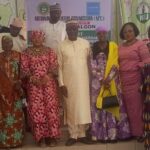
Adding a symbolic but politically significant layer to Odunuga-Bakare’s candidacy is the public endorsement of Alhaja Lateefat Gbajabiamila, mother of Femi Gbajabiamila, which has been interpreted within Surulere APC circles as a signal of elite-level alignment within the constituency’s internal power structure.
Her endorsement took place during an engagement organised by the “Converge of the People” foundation, where she offered prayers for Odunuga-Bakare and described her as a “round peg in a round hole” for leadership within Surulere. In Lagos political culture, such phrasing is rarely treated as casual praise, particularly when it emerges from politically influential family networks.
Beyond its personal tone, the endorsement carries interpretive weight within elite political communication systems in Lagos, where family-linked statements from established political households are often read as indirect reflections of broader structural sentiment rather than isolated expressions of goodwill. This is especially relevant in constituencies where political alignment is frequently signalled through informal channels rather than official declarations.
Her remarks also highlighted the importance of increased female participation in political leadership, situating the endorsement within ongoing conversations about gender inclusion and representation within Lagos State governance and party structures.
Within this context, the endorsement functions less as a standalone gesture and more as an additional layer of reinforcement within Odunuga-Bakare’s evolving political positioning, particularly as she consolidates support across both elite networks and grassroots structures ahead of the 2027 APC primaries.
The Emerging Contest: Incumbency Versus Structural Repositioning
The APC primary in Surulere Constituency I is increasingly taking shape as a structured internal contest between two distinct political logics: incumbency consolidation on one side, and internal structural repositioning on the other. Rather than a conventional two-candidate race, it is being interpreted within party circles as a test of how far existing political equilibrium within Surulere APC can accommodate emerging shifts in influence.
Desmond Elliot enters the contest with the institutional advantage of incumbency, which in Lagos legislative politics extends beyond visibility in the House of Assembly. It includes sustained constituency recognition, established access to ward-level party executives, and familiarity within delegate mobilisation networks that are often decisive in internal primaries. His political strength is rooted in continuity, reinforced by years of legislative presence and integration within the constituency’s existing political order.
Odunuga-Bakare, on the other hand, presents a different form of political capital anchored in layered institutional experience. Her profile combines grassroots legislative exposure at the ward level, executive governance experience within the Lagos State administration, and direct participation in APC campaign architecture. This combination places her within both the operational and administrative spheres of party politics, rather than a single tier of political engagement.
This contrast creates a contest defined less by ideological difference and more by structural positioning within the party system. On one side is the logic of continuity, where incumbency is viewed as a stabilising factor within constituency representation. On the other is a logic of internal recalibration, where political actors with multi-level governance exposure are increasingly being considered within succession conversations.
Within Surulere APC, this dynamic reflects broader questions about how political authority is distributed across time, networks, and institutional participation. The contest is therefore not only about individual ambition but about how the party interprets renewal within an established power structure ahead of the 2027 electoral cycle.
Surulere at the Centre of Lagos APC’s Internal Power Reordering
Surulere Constituency I is increasingly reflecting a broader pattern within Lagos APC politics, where influence is not redistributed through abrupt breaks but through gradual recalibration of internal networks, shifting loyalties, and evolving elite alignments. Within this framework, the constituency is emerging as a microcosm of how the party manages internal continuity while accommodating new political actors shaped by different tiers of governance experience.
What is unfolding in Surulere is therefore not simply the emergence of a new aspirant against an incumbent, but a more layered negotiation of authority within an established political ecosystem. The dynamics extend beyond individual candidacies to the underlying structure that determines how political relevance is defined, sustained, and transferred within the constituency over successive electoral cycles.
This includes the interaction between ward-level mobilisation structures, state-level executive influence, and long-standing campaign networks that collectively form the backbone of Lagos APC’s internal organisation. Each of these layers contributes differently to how succession conversations are shaped, particularly in constituencies with strong historical political continuity.
As the APC moves toward the 2027 electoral cycle, Surulere is increasingly positioned as a key reference point for understanding how internal competition is managed within entrenched political blocs. The constituency’s unfolding dynamics offer insight into how Lagos APC balances incumbency stability with emerging structural repositioning, without disrupting the broader equilibrium that sustains party cohesion.
In that sense, Surulere is not merely a contested seat but a working example of Lagos APC’s internal political architecture under subtle transition, where continuity and recalibration operate simultaneously within the same governing framework.
Share this