

The Centre for Children’s Health Education, Orientation and Protection (CEE-HOPE), in collaboration with the Rosa Luxemburg Foundation West Africa, has trained domestic workers in Lagos and Ogun states on their labour rights amid concerns over widespread exploitation, poor remuneration, physical abuse and inadequate legal protection in the sector.
The training, titled ‘Advancing Legal Awareness and Decent Work for Domestic Workers,’ was held on Thursday at CEE-HOPE’s Lagos office, with legal, labour and human rights experts educating participants on existing legal protections, collective bargaining and practical ways to address workplace abuses.
One of the participants, Blessing Iduma, shared her experience of exploitation, recounting how she was brought from Benue State to Lagos at the age of nine by her aunt, who promised to enrol her in school but instead subjected her to years of child labour and physical abuse.
Blessing recalled that her aunt had a daughter whom she expected to attend school alongside, but the woman later told her she could not afford to pay her school fees and instructed her to hawk cooked rice instead.
“She had a daughter that we were supposed to be going to school together. But she said she didn’t have the money to pay for me, that I should hawk cooked rice for her. So, I started hawking rice for her at the age of nine,” she said.
Instead of attending school, Blessing’s childhood became a routine of hard labour. She hawked cooked rice during the day, sold vegetables at night and performed household chores in between.
“I would hawk rice in the morning, in the afternoon she would cook again, I would still hawk it. Immediately I returned from hawking, she would send me to a farm to get vegetables which I would sell in the Igando market at night. Before I sleep, she would say, ‘Oya, go and fry garri,’” she recounted.
Blessing said she was never enrolled in school, while attempts to question her situation or remind her aunt of the promise of education were met with physical abuse.
Determined to escape, she secretly saved part of the money she earned from hawking. After saving enough to cover her transportation fare to Benue State, she seized an opportunity to flee the house and return to her village.
CEE-HOPE founder, Betty Abah, said the training was organised to address the vulnerabilities domestic workers face and the exploitation employers often subject them to, including underpayment, arbitrary termination of employment, indefinite working hours and physical abuse.
Abah stressed that strengthening workers’ collective bargaining power was essential to transforming domestic work from an isolated and vulnerable occupation into a recognised and regulated profession.
She described the workshop as a crucial part of CEE-HOPE’s broader advocacy to unionise domestic workers in Nigeria, adding that the organisation was working towards a society where male and female domestic workers are recognised, protected and treated with dignity.
Domestic Workers Face Poor Pay, Abuse, Lack of Employment Protection
Following the opening address, participants received presentations from three resource persons, who examined the realities of domestic work, existing legal protections and practical ways workers could demand their rights.
Labour migration and informal work expert, Lekan Abdulazeez Soneye, in a presentation titled ‘Domestic Workers as Invisible Workers,’ highlighted the difficult working conditions and widespread exploitation in the sector.
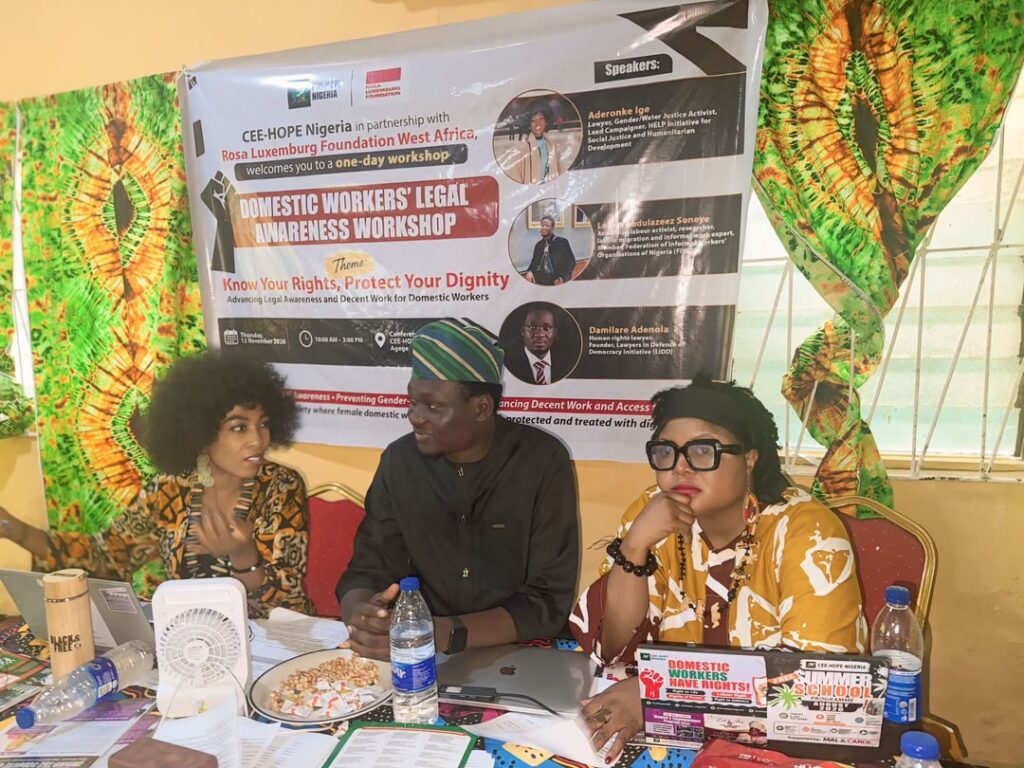
“There are more than four million domestic workers in Nigeria who are poorly paid and in different forms of abuse,” Soneye said.
He lamented that labour institutions, including the Ministry of Labour, labour support organisations and trade unions, pay little attention to the challenges facing domestic workers.
According to him, academic institutions and labour researchers have also shown limited interest in domestic work as a field of labour studies, partly because of the invisibility of the work and the absence of adequate structural recognition.
Soneye explained the concept of collective power, describing it as the ability of individuals to recognise their shared interests, organise themselves and take collective action towards achieving common goals and prosperity.
He identified four major sources of collective power as associational, structural, societal and institutional power.
Highlighting the poor working conditions in the sector, Soneye presented data showing that decent work, including regulated working hours, job security, adequate remuneration, holidays, gender rights and protection from abuse, remains largely inaccessible to domestic workers in Nigeria.
“In fact, only about 15 per cent of domestic workers in Nigeria have a clearly defined and written contract with their employer, with a significant proportion of this 15 per cent being defined on behalf of the workers, and only about seven per cent of them earn ₦50,000 or above,” he said.
He further disclosed that 62 per cent of domestic workers had experienced verbal abuse, nine per cent had experienced physical abuse, while four per cent, all female, had experienced sexual abuse.
According to him, only nine per cent of reported abuse cases were satisfactorily addressed.
Soneye identified several existing legal frameworks that could protect domestic workers, including the Nigerian Labour Act, the 1999 Constitution, the Anti-Trafficking Policy of 2003, the Employee Compensation Act of 2010 and the Labour Migration Policy of 2013.
However, he noted that Nigeria had yet to ratify and implement the International Labour Organisation’s Convention 189, adopted on June 16, 2011, which provides for decent working conditions and protections for domestic workers.
He said CEE-HOPE had advocated for policies recognising and protecting domestic workers, including provisions for their unionisation, before the National Assembly in July 2024.
According to him, the advocacy contributed to the adoption of the Bill for the Documentation and Protection of Domestic Workers in November 2025, although the ratification of ILO Convention 189 remained outstanding.
Soneye urged domestic workers to build collective power through associations, public engagement, workplace organisation and institutional advocacy.
He acknowledged that outright strikes could be difficult for domestic workers because of job insecurity but noted that collective action could also involve negotiating sick leave, family emergency provisions and other workplace conditions that demonstrate the economic value of their services.
Experts Advocate Legal Protection, Collective Action and National Union
Providing further legal perspectives, gender justice activist and lawyer, Aderonke Ige, who is also the lead campaigner at the HELP Initiative for Social Justice and Humanitarian Development, shared insights from her years of litigation and advocacy across Oyo, Ekiti and Lagos states.
Ige examined the different institutional responses to gender-based violence and violations of workers’ rights, highlighting efforts by Lagos and Ekiti states to establish protective mechanisms.
She cited initiatives such as public defender offices, domestic and sexual violence response centres and sexual offender registries as important steps towards improving access to justice.
However, she cautioned that gaps in grassroots enforcement and cross-border jurisdictional challenges continued to prevent vulnerable victims from obtaining timely justice.
Also speaking, human rights lawyer and founder of the Lawyers in Defence of Democracy Initiative (LIDD), Damilare Adenola, discussed practical strategies domestic workers could adopt to access legal assistance, report abusive employers and seek support through civil society organisations.
Adenola emphasised the importance of understanding constitutional rights and using pro bono legal services as safeguards against employer impunity.
Concluding the training, Abah urged domestic workers to remain committed to building a structured and vibrant national union capable of advancing their collective interests.
She disclosed that the organisation’s mobilisation efforts had largely focused on Lagos and Abuja, with participation from neighbouring states, including Ogun and Nasarawa.
Abah, however, said CEE-HOPE intended to expand the campaign into a nationwide movement, enabling domestic workers’ unions to become part of the mainstream labour movement and contribute to significantly improved working conditions across the country.
Share this


