

By Omotosho Michael |
The Agip Recital Hall at the MUSON Centre was not merely a venue for a birthday celebration, but a crucible for a radical intellectual reawakening. As Professor Biodun Jeyifo (BJ) marked his 80th year, a distinguished assembly of scholars, activists, and former students gathered under the auspices of the Wole Soyinka Centre for Investigative Journalism (WSCIJ) to deliver a blistering critique of contemporary African education and politics.
The symposium, themed “Pedagogy, Curriculum and Decolonization: Then and Now,” served as a critical appraisal of the Nigerian educational system and the unfinished business of decolonizing the African mind. Organized by the Wole Soyinka Centre for Investigative Journalism (WSCIJ), the symposium moved beyond the typical celebratory rhetoric, instead issuing a stern “State of the Union” regarding the decline of radical scholarship in Africa.
The symposium Opening Remarks: A Legacy of Disciplined Modesty was chaired by Dr. Yemi Ogunbiyi, Chairman of Tanus Books and a long-time associate of the celebrant. In his opening remarks, Dr. Ogunbiyi set the stage by describing Professor Jeyifo popularly known as BJ as the conscience of the Nigerian academy. He noted that Jeyifo’s tenure as the founding president of the the Academic Staff Union of Universities (ASUU) was defined not by a quest for power, but by a commitment to the university as a site of national liberation.
The Keynote: Confronting the Fear of Change
The intellectual keynote centerpiece of day was delivered by Professor Priya Gopal of the University of Cambridge. Her lecture, Who’s Afraid of Decolonization? Reflections on Particular Pasts and Planetary Futures, challenged the audience to view decolonization not as a nostalgic look at the past, but as a survival strategy for the future. “Decolonization is not a metaphor; it is a dismantling,” Gopal asserted. She argued that the current global resistance to decolonial thought seen in both Western and African institutions is fueled by a fear of a world where power is truly horizontal.
Gopal argued that the curriculum remains a battlefield, asserting that the resistance to decolonizing education in Nigeria and abroad stems from a fear of losing the Eurocentric comfort zone that sustains global inequality. She praised Jeyifo for his lifelong refusal to seek permission from the West to validate African social and literary realities.
Panel I: Decolonization as a Political Project
The first panel, featuring Professor Jibrin Ibrahim, Dr. Chidi Amuta, and Professor Akin Adesokan, interrogated the disconnect between pedagogical theories and the Nigerian political reality.
Professor Jibrin Ibrahim delivered a sharp political analysis, noting re-colonization of the Nigerian university system was hijacked by an elite class that merely replaced white masters with black ones. He also argued that the current curriculum produces graduates who are technically skilled but politically illiterate. In other words the current curriculum is designed to produce compliant subjects for a dysfunctional state rather than critical citizens for a liberated nation.
Dr. Chidi Amuta provided a sociological deep-dive into Jeyifo’s work, describing him as a Radical Humanist who understood that literature is not a luxury but a social practice, and successfully shifted literary criticism from the ivory tower to the streets. He called for a return to the Ife School of thought, where education was directly tied to the liberation of the masses.
Professor Akin Adesokan focused on the geography of knowledge. And emphasized that decolonization cannot happen in a vacuum. He pointed out that as long as Nigerian scholars are forced to publish in Western journals to gain promotion, the center of gravity for African knowledge will remain outside the continent.
Panel II: The Ife Years and the Pedagogy of Liberation
The second session brought a more personal yet equally rigorous perspective, featuring Jeyifo’s former students and mentees: Dr. Bisi Anyadike, Mr. Kunle Ajibade, and Dr. Ogaga Ifowodo.
Kunle Ajibade, Executive Editor of TheNEWS, gave a stirring account of Jeyifo’s classroom at the University of Ife (now OAU) in the late 70s. He described a pedagogy of provocation where students were taught to question everything, including the very texts they were studying. He also gave a moving account of being Jeyifo’s student, describing how BJ didn’t just teach books; he taught the politics of the comma. He noted that Jeyifo’s classroom was a space where the hierarchy of teacher and student was dissolved in favor of a collective search for truth.
Dr. Ogaga Ifowodo reflected on Jeyifo’s principled poverty, noting that the celebrant’s refusal to chase government appointments or material wealth allowed him to speak truth to power with unparalleled authority. And how Jeyifo’s legacy as the founding President of ASUU fight was never just about salaries, but about the soul of the university and its autonomy from military and civilian autocrats.
Dr. Bisi Anyadike highlighted Jeyifo’s role in institution-building, noting that “BJ didn’t just write books; he built the structure that allowed others to find their voices.”
The Celebrant’s Response: The Struggle Continues
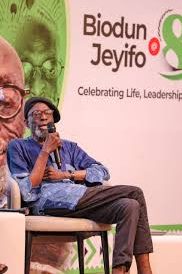
The most anticipated moment came when Professor Biodun Jeyifo himself took the lectern. Rather than a standard thank you speech, he delivered a philosophical charge: Curriculum, Society, and Revolution Across Generations.
Professor Biodun Jeyifo addressed the hall with the same sharp, analytical vigor that has characterized his sixty-year career. He expressed concern over the intellectual fatigue currently facing the Nigerian academy but expressed hope in the younger generation of scholars and activists.
Jeyifo stated, “Curriculum is not just a list of books; it is a map of our world, if we do not draw our own maps, we will always be lost in someone else’s territory.”
Closing the event, Professor Biodun Jeyifo, the man affectionately spoke with the same sharp clarity that has defined his 60-year career. Reflecting on “Curriculum, Society, and Revolution Across Generations,” he reminded the audience that the university is only useful if it serves as the conscience of the nation.
“The struggle for a decolonized curriculum is the struggle for the soul of the country,” Jeyifo said. “We must not be afraid to dismantle the old to build the new.” The event concluded with a vote of thanks from Motunrayo Alaka, Executive Director of the WSCIJ, who emphasized that the symposium was part of a broader effort to ensure that the intellectual rigor of pioneers like Jeyifo is preserved for future generations of journalists and scholars.
The event stood as a testament to Jeyifo’s 80-year journey: a life dedicated to the belief that the mind, once truly decolonized, can never again be enslaved.
Share this


